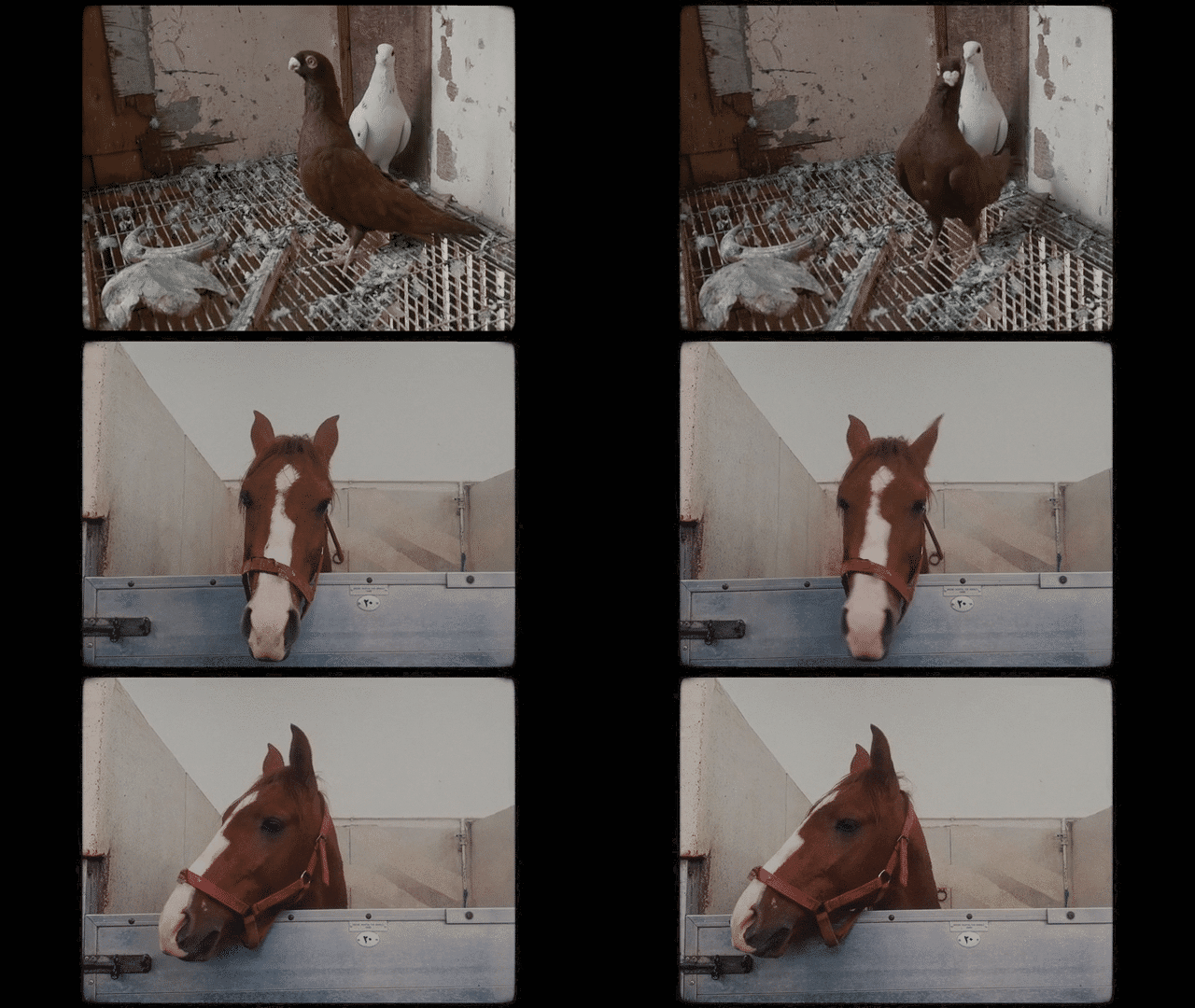
Je suis partout et nulle part Ă  la fois
Portugal French and Portuguese. English subtitles This coming of age film follows Filipe and Hugo while they spend the summer in Trás-os-Montes, Portugal. From childhood memories, lazy summers filled with boredom, to their aspirations of a better life, the film explores the ambiguous relationship these youngsters foster with rural Portugal, and their way they navigate across various identities, languages and terrains. Then Director writes: Film-making was a central component of the project, since the research design. It enabled to create a long term relation with the participants, and to access their memories and imaginations. But also, in a project focusing on the making of places in peripheries, it enabled me to highlight particular landscapes and rural areas' atmospheres and architectures. Portugal is a country of emigration: one in five Portuguese live abroad. In the last decades, the regions bordering Spain are the most affected by these departures In the northeastern region of Trás-os-Montes, a third of the population has left since the 1960s. This is where I met with two youngsters, sons and grandsons of emigrants: Hugo and Filipe. Hugo lives close to Paris and spends every summer at his grandparents’ in Trás-os-Montes. There he reconnects to his roots and the slow pace of the village. Filipe did the same: for years, he spent every summer at his grandma’s before his family eventually moved back to Portugal, a few kilometres from his grandma’s home. But what awaited him once he graduated from the local college? As many before him, he emigrated. When we meet, during the summer 2019, he works in London. In February 2020, the world enters a pandemic Filipe is laid off, he packs and comes back to his village in Portugal. Filipe dreams of new horizons, and the answer lays in front of him of going back to where he was born, Paris. While Hugo, in Paris, dreams of living and working in Portugal but, not in the village, not in Trás-os-Montes This is a film about a region which performs as a shrine, a physical container of memories of happy childhoods and simpler times, that one visits once a year and puts a small bouquet of flowers at its feet. Some stay close-by, and live out of its pilgrims, but very few are able to experience it as a real and viable home.

Je suis partout et nulle part Ă  la fois

(un)clean (un)seen
Lumbini, Nepal Nepali Sanitation workers are at the forefront of climate change working in increasingly challenging conditions, often without protection. The film was used to document the final performance of 12 sanitation workers in Nepal. The sanitation workers had attended a series of participatory arts workshops as within an international, interdisciplinary research programme 'Towards Brown Gold' that explored shit, wastewater and marginality in five rapidly developing off-grid towns. The performance and film sought to raise awareness of issues affecting sanitation workers, some of the most precarious workers in the world. This is a performance by twelve sanitation workers in Nepal supported by UK artist Alice Fox and Nepali arts-activist Ashmina Ranjit. The performance was just one element of an international, interdisciplinary research programme on sustainable sanitation, wastewater and marginality. The film documents the performers as they travel to the Women of the World festival held in Lumbini Peace Park Nepal in 2022. Can the performance enhance dignity and respect for the local sanitation workforce? support arts-based forms of knowledge making? surface issues of caste and untouchability? or push sanitation worker rights up the agenda? The film gave apparent value and status to the project (from the perspective of these sanitation workers). If we had more time and contacts (which we do now) we would co-produce the film as well as the performance with a local film maker. The film has been a useful teaching tool to commence discussions around sanitation, untouchability and womens labour in conjunction with other more didactic resources.

(un)clean (un)seen

Stories of Loss and Love
Holy Island, England English This short film-poem (55 sec) was made by Ceri Morgan (prose-poet) and Pawas Bisht (documentary film-maker) last summer as part of a project led by Bisht entitled, 'Participatory Storytelling and Arts for Inclusive and Transformative Nature Recovery and People-Nature Connection'. The film-poem was made following a site visit to Holy Island with Natural England, and came out of conversations around artistic/knowledge form(s), audience engagement, tensions between place-making and place-safekeeping, and the impact of climate change, including coastal erosion. In the final line, the sea is poised ready to swallow the island like an oyster/pearl. Field notes were made (written, photographs, moving images) during a site visit that was also a participatory activity, featuring discussions with a community group, artists and colleagues working on sustainability and/or environmental history, and Natural England colleagues. Morgan then wrote a word-based prose-poem based on these notes and discussions, which Bisht combined with film footage he took on the day to make a film-poem. The method aimed to explore and experiment with forms that could be both art and criticism/research within geohumanities and environmental humanities. The film-poem appears to be more effective than either the word-poem or the film on their own. It seems accessible in terms of speaking to a broad audience, and viewers have been very moved by it. Challenges were technical ones - how to write a prose-poem that would include an environmental message without 'telling' (something to avoid in creative writing), and how to make the film fit the text (this required extensive editing).

Stories of Loss and Love