Did to didi: A message from domestic worker to domestic worker
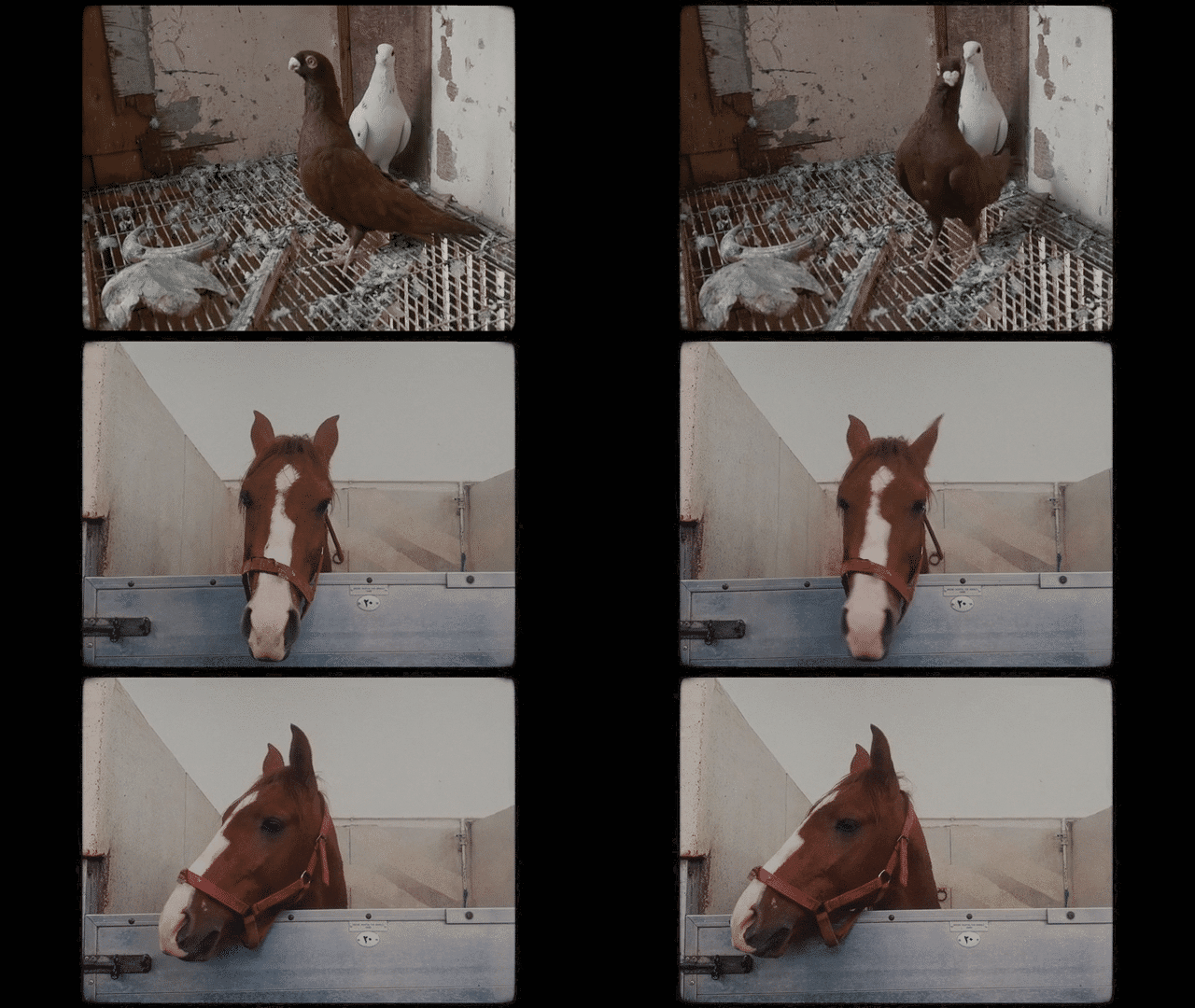
Nepal Nepali with English subtitles [Nepali title]: “Didilai didiko sandesh” The ‘Didi to didi’ project is a film written for domestic workers by domestic workers in Nepal. The film explores the hidden issues and constraints domestic workers face daily, yet are unable to validate with a community of workers due to the relative isolation of their working conditions. This film ‘acts’ upon the domestic work industry by breaking down information silos which keep women in the dark on the norms and conditions that pervade their own work. Through the questions and advice format, the film ultimately inspires and encourages domestic workers in Nepal and around the world on themes of agency, economic equality and dignity of work. "The film explores the relational and material processes shaping domestic work through the experiences of six domestic workers in a city of Nepal. It highlights the separation of domestic workers from one another, and the information gaps which can marginalize women from understanding and bargaining for better conditions in their work. The film gives a window into the experience of domestic work by sharing a hypothetical conversation between domestic workers, and the questions or advice they have for one another. Questions which women have foregrounded in the film include how other domestic workers relate to time pressure (and a lack of control over their own time), the relationship between employers and employees (including by what names employers call domestic workers), the coping mechanisms women turn to due to their low salaries, as well as how families navigate child workers. The advice section is a call, from one domestic worker to another, to claim more overt labor agency despite the challenges and unfreedoms which often characterize the workplace for workers. Women’s advice alludes to the many constraints and exploitative conditions they find themselves in, but shows the ways they cope with or challenge the current status quo. My research explores the domestic work industry in Hetauda, Nepal, examining the institutions, inequalities and power dynamics which have enabled this industry to emerge and continue in recent years. The findings of the research concentrate around women’s labor market decisions into and through domestic work, characterizing the relationship and agencies of employers and employees, and developing theory which understands the labor market processes of domestic work which are co-produced through socially reproductive labor and ‘productive’ labor. During this broader project, it became clear that women desired to speak with other domestic workers about their experiences, but didn’t have an outlet to do so. The film was developed to contribute to this need, and thus, focuses on the key pieces of information domestic workers choose to share, rather than communicating the broader research findings. In this process, academic, practitioner and policy-making audiences have a window into the key pieces of information domestic workers may be missing, as well as the key obstacles they are currently overcoming, or have learned to overcome through their work. Film making added to my project by allowing my research to go beyond my own intellectual interests, and respond to a real need for connection and collaboration my research participants were expressing. Challenges included finding the time in women’s extremely busy work schedules to shoot the film, as well as ensuring consent was ethically and clearly obtained not only from domestic workers but also from their employers, given that we largely filmed in women’s workplaces. Future challenges will include getting the film in front of as many domestic workers as possible through social media, as the film’s key objective is to reach and encourage otherwise difficult to find domestic workers."

Did to didi: A message from domestic worker to domestic worker

Spiritual Flavours
London, UK Spiritual Flavours interweaves biographical narratives and spiritual accounts from Betty, Aziz and Ossie (who belong to a Catholic church, a mosque and a liberal synagogue, respectively) with the experiences of cooking in their homes in Ealing, London. The recipes thread narratives of past, present and future aspirations, spirituality and the everyday. Their commonalities and differences are expressed through visual and sonic synchronies and asynchronies. Also, by overlapping soundscapes of cooking and praying, the film develops a rhythmic and affective experience of the relationship between food and religious practices. At the end, Betty, Aziz and Ossie meet, cook and eat together. "This film is part of my interdisciplinary doctoral research "Spiritual Flavours: Reflections on using creative practice to explore food and religion in a multi-faith suburb" (2022). This investigates the relationship between food and religious material practices of several faith communities in Ealing, a suburb in West London, selected to represent different faith and migration traditions. These include a Synagogue, a Sri Lankan Hindu Temple, a mosque, a Sikh Gurdwara, an Anglican church, a Roman Catholic church and an ethnically diverse Pentecostal church. The research developed an arts project, Spiritual Flavours, which comprises a photographic series, a film (5' and 28'), and an artist cookbook. Whilst the photographic series uses a formal approach, devoid of people, to explore the spatial arrangements of commensality within religious buildings, the cookbook and the film focus on participatory engagement and biographical narratives. These bring together a diverse range of intimate experiences of food and spirituality across both domestic and worship spaces, and expose the nuanced ways in which faith, age, gender, identity, migration, community and home intersect. The film also produces a rhythmic and multi-sensory experience through the use of the split-screen technique and the creative mixing of sounds of cooking and prayer." More information available at www.spiritualflavours.com.

Spiritual Flavours

Harbouring Illness
London, UK "Harbouring Illness" is a portrait of three women living with long-term health conditions in an East London neighbourhood. Through their stories, the film offers insight into the everyday challenges of living with chronic illness amidst an overstretched and underfunded healthcare system. It delves into the effects of social isolation and the struggles that come with maintaining a healthy life in the face of substandard living conditions. "Harbouring Illness" invites the viewer to contemplate new possibilities for living a flourishing life beyond the confines of conventional medical understandings of health and well-being. "Multimorbidity, commonly defined as the co-occurrence of two or more long-term health conditions, is considered a major challenge to contemporary care services. Why multimorbidity poses such a challenge and what kind of challenge it is, is not straightforward. In the short documentary "Harbouring Illness" I explore the experiences of working-age adults living with multimorbidity in a socio-economically deprived borough in London. Starting from a photography project, I involved three study participants in the production of this film. In particular, we explore the effects of social isolation and the struggles that come with maintaining a healthy life in the face of substandard living conditions. I found that taking the time to interact closely with a specific location enabled me to forge deeper connections with that place, and to respond creatively in a way that sought connections between the traces of the past and the detail of the present. I found that following instinct and allowing the process to develop organically resulted in a piece that was led by the place interaction, rather than being dictated by preconceived ideas. And that the process of pulling together the audiovisuals with poetic ideas in the editing suite generated new creative ideas and a lasting connection to the place encountered."

Harbouring Illness

Literate
Nepal Nepali with English subtitles Three Nepali siblings from the village document their new lives as city dwelling, young adults. "After making two films about the Darnal family—Drawing the Tiger (2015) and The Eldest Son (2017)—the filmmakers recognized the curiosity of the Darnal teenagers to be behind the camera and document their own lives. Literate is a collaborative, experimental documentary with Sarita, Rashmita and Ram Kumar Darnal as the directors of photography. The film has been edited from their footage, shot over two years. It is a piece still in process, part of a larger, ever-evolving project of documenting the Darnals’ lives over the past decade. Though making documentaries has become more accessible than ever, we recognize that doing so has essentially remained an art of the privileged. Since we started filming the Darnal family in 2008, our films have been part of a deepening and increasingly urgent conversation about whose story is being told, and by whom. ‘Subject,’ ‘character,’ ‘protagonist,’ ‘participant,’ ‘collaborator’—all are used to describe those who appear in a documentary—but to varying degrees, all center the gaze of the producers. We have interviewed Sarita, Rashmita and Ram Kumar about growing up in the village, their education, how they see their futures. We captured and controlled their stories via our western, documentary and narrative lenses. After having pointed cameras at them for many years, we wanted to know what they would choose to show of their own lives. Literate is an exploration of how the Darnals express themselves from behind the lens. Literate does not follow a story arc, but is a collection of images from three young Nepalis during a huge transition in their lives—leaving their village to come to the city as the first in their family to read and write. What do they see? What do they want to say? We have known Sarita, Rashmita and Ram Kumar Darnal since 2011, when they were small children. They participated in two of our previous films, which focused on their older sister and brother. While in production on these projects, the younger kids would pick up our cameras and shoot around the village with their friends. We loved finding these images among our footage. It was like behind-the-scenes from our documentarian presence. Spurred by Nepal’s earthquake, the Darnal family made the decision to move to Kathmandu in 2017. It was at this time the three siblings, now young adults, expressed interest in filming their new lives as city dwellers. We applied for a grant to purchase cameras. The cinematographer on our two previous projects, Shailendra Karki, created a camera training course for them. Our instructions for Sarita, Rashmita and Ram Kumar were the following: Turn on and point the camera when and in the direction you feel compelled; to show the story you want to tell. We then braided their footage together. We are submitting this as a Work-in-Progress due to the project being stalled by the pandemic. We will incorporate more of their commentary in its next rendition. From our ‘fly on the wall’ footage during our previous films with the Darnals, it was not uncommon for a mic’d family member to reflect upon us and our experience: “Why does Amy want to film me do the dishes again? She must be bored. I hope she is not too hungry and hot in the sun.” Although we did not appear on camera, we, the filmmakers, were very much part of the films. When we received the Darnal siblings’ footage via a DHL package in Seattle, it was like Christmas morning. To watch each file was thrilling—to see what they chose to focus on. Ram Kumar witnessing electricity’s arrival in the village of his childhood. Sarita and Rashmita, inseparable sisters, free for the first time as young women going to school in Kathmandu. After watching Literate, all three cinematographers reported feeling the film is not yet complete. They loved filming and felt it empowering. They would like to film more, especially if it could be a paid job. (They did receive a stipend for their participation in this project.) The blocking issue is their very busy lives. Ram Kumar and Rashmita work six long days a week and have only Saturdays to do their housework. Sarita is now married and is newly a mother. Our experience of exploring cultural geography is from a documentary film lens. Our plan is to continue this project with the next step of including the Darnal siblings in the editing process. This to us would be a further dive into this film collaboration. How would they arrange and now comment on the scenes they filmed? What would they say about this footage now that they are older, post-pandemic and calling Kathmandu home?"

Literate

Stories of Loss and Love
Holy Island, England English This short film-poem (55 sec) was made by Ceri Morgan (prose-poet) and Pawas Bisht (documentary film-maker) last summer as part of a project led by Bisht entitled, 'Participatory Storytelling and Arts for Inclusive and Transformative Nature Recovery and People-Nature Connection'. The film-poem was made following a site visit to Holy Island with Natural England, and came out of conversations around artistic/knowledge form(s), audience engagement, tensions between place-making and place-safekeeping, and the impact of climate change, including coastal erosion. In the final line, the sea is poised ready to swallow the island like an oyster/pearl. Field notes were made (written, photographs, moving images) during a site visit that was also a participatory activity, featuring discussions with a community group, artists and colleagues working on sustainability and/or environmental history, and Natural England colleagues. Morgan then wrote a word-based prose-poem based on these notes and discussions, which Bisht combined with film footage he took on the day to make a film-poem. The method aimed to explore and experiment with forms that could be both art and criticism/research within geohumanities and environmental humanities. The film-poem appears to be more effective than either the word-poem or the film on their own. It seems accessible in terms of speaking to a broad audience, and viewers have been very moved by it. Challenges were technical ones - how to write a prose-poem that would include an environmental message without 'telling' (something to avoid in creative writing), and how to make the film fit the text (this required extensive editing).

Stories of Loss and Love

1 2 3