A ‘Dash of Home’
Te Whanganui-a-Tara Wellington, New Zealand A ‘Dash of Home’ participates in the settler-colonial practices of seeing Indigenous land through European image-making practices. Drawing from historical colonial images of Te Whanganui-a-Tara Wellington in Aotearoa New Zealand, the film disrupts the English settler’s drive to see a ‘dash from Home’ in colonial images. The film co-opts colonial image-making strategies by introducing more-than-representational materials into the space of drawing. A ‘Dash of Home’ offers a critical engagement with colonial imagery that gives historical images immediacy, emphasising the material impact of historical representations on the past, present and future. A ‘Dash of Home’ participates in the settler-colonial practice of contemplating Indigenous land as European landscape. Lifted from the publication English Reaction to the New Zealand Landscape, the phrase ‘dash from Home’ describes the strategy of portraying Aotearoa New Zealand, through the landscape preferences of future setters. A ‘Dash of Home’ foregrounds the collective and iterative processes in which colonial images are made. Botanical illustrations from James Cook’s first voyage, town plans and ‘on the spot’ views of Te Whanganui-a-Tara Wellington, produced by the New Zealand Company, were drawn and re-drawn, passing through different hands, changing mediums, and travelling between different lands. Each re-drawing presented the physical aspects of the land but, more significantly, heightened the drawings’ affective qualities, becoming a vehicle for ongoing colonisation. This film seeks ways of altering the ‘dash of home’ mentality through simple and literal moves of adding and extracting materiality within the fictional space of the drawing. A ‘Dash of Home’ continues the tradition of adding the familiar to an unknowable land but equally explores what conceptions of home must first efface before contemplation can take place. "After making the film, I began to reflect on the commonalities between the different representations shown in the work: botany, town plans and landscape scenes. This led to the eighteenth and nineteenth-century practice of scientific illustration called ‘truth-to-nature.’ Scientists and artists collaborated to represent the typical or ideal seen in nature. In the context of my work, truth-to-nature provided a linking mechanism between botany and the more expansive geographical projections, such as landscape plans and perspectives. I began to interpret my work as co-opting or extending truth-to-nature to a broader range of colonial representations. My approach and understanding of ‘truth’ are reimagined in this work. ‘Truth’ in truth-to-nature is not what was physically seen but a kind of contemplative sight. A sight that is distanced from the existing world, allowing new, usually detrimental, ways of seeing. In my work, the idea of ‘truth’ is still emerging. One interpretation is that truth is found in revisiting a specific location’s past and showing that its historical representations have real material effects while offering a mode of inquiry for countering a singular future. Films’ duration, movement and sound offer vitality and immersive affects to our interaction with historical images. For this project, film is a medium that makes the images feel immediate. Film, as opposed to still images, also offered a way to show my participation with the images through time, not fixed in time, as with the source images. One challenge of this project was finding nuance to the tactic of staging colonial image-making strategies while simultaneously countering them."

A ‘Dash of Home’

Maalik
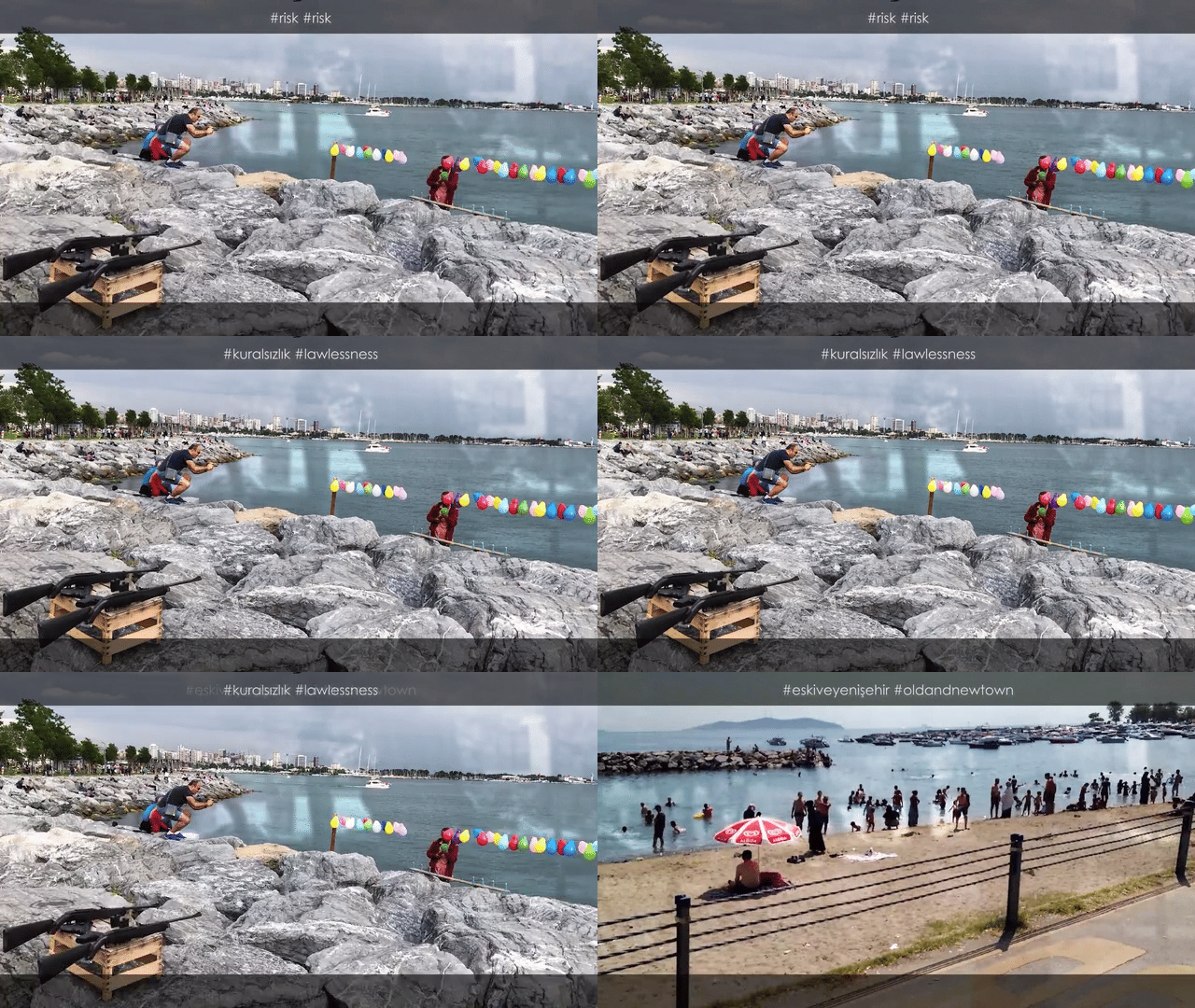
Hunza Valley and Kech Pakistan Balochi with English subtitles The film shows how the filmmaker is pre-occupied in his subconscious, he is constantly entangled with thoughts of his identity in addition to the circumstances he is living in. As film progress he goes home, to seek peace. The film is a documentary, fictionalized by following the cinematic tradition of filmmakers from French new wave like Alain Resnais, Chris Marker and many more. The film's self reflective and self referential nature qualifies it as an essay film. It contextualizes the motif of mountains and barren land in very new and fresh way. The visual and the sound is dialectically juxtaposed for the subject who finds peace in the unrest and restlessness in a peaceful place. The film is visually divided into two parts, initially filmmaker where he is struggling to attain peace in mountains. Overall, composition of the frame is very dynamic. Whereas the framing in the end portion is completely different, almost opposite of it. In sound design, gunshots were added to enhance the mental disturbance of the filmmaker. The goal of the film was to show how human beings are being normalised into conditions which are not appropriate to live in. The conflict of sub conscious and existing reality of filmmaker about where he belongs. "I think experimental film making was key point for me to work on this project and its techniques. When I was filming in my hometown, security threats were something which made me think twice before opening my camera to shoot. Because we can't openly film there, states operatives always try to impose their narrative and poses a real threat to life for example forced disappearance, and being abducted. These ground realities were highlighted."

Maalik

Literate
Nepal Nepali with English subtitles Three Nepali siblings from the village document their new lives as city dwelling, young adults. "After making two films about the Darnal family—Drawing the Tiger (2015) and The Eldest Son (2017)—the filmmakers recognized the curiosity of the Darnal teenagers to be behind the camera and document their own lives. Literate is a collaborative, experimental documentary with Sarita, Rashmita and Ram Kumar Darnal as the directors of photography. The film has been edited from their footage, shot over two years. It is a piece still in process, part of a larger, ever-evolving project of documenting the Darnals’ lives over the past decade. Though making documentaries has become more accessible than ever, we recognize that doing so has essentially remained an art of the privileged. Since we started filming the Darnal family in 2008, our films have been part of a deepening and increasingly urgent conversation about whose story is being told, and by whom. ‘Subject,’ ‘character,’ ‘protagonist,’ ‘participant,’ ‘collaborator’—all are used to describe those who appear in a documentary—but to varying degrees, all center the gaze of the producers. We have interviewed Sarita, Rashmita and Ram Kumar about growing up in the village, their education, how they see their futures. We captured and controlled their stories via our western, documentary and narrative lenses. After having pointed cameras at them for many years, we wanted to know what they would choose to show of their own lives. Literate is an exploration of how the Darnals express themselves from behind the lens. Literate does not follow a story arc, but is a collection of images from three young Nepalis during a huge transition in their lives—leaving their village to come to the city as the first in their family to read and write. What do they see? What do they want to say? We have known Sarita, Rashmita and Ram Kumar Darnal since 2011, when they were small children. They participated in two of our previous films, which focused on their older sister and brother. While in production on these projects, the younger kids would pick up our cameras and shoot around the village with their friends. We loved finding these images among our footage. It was like behind-the-scenes from our documentarian presence. Spurred by Nepal’s earthquake, the Darnal family made the decision to move to Kathmandu in 2017. It was at this time the three siblings, now young adults, expressed interest in filming their new lives as city dwellers. We applied for a grant to purchase cameras. The cinematographer on our two previous projects, Shailendra Karki, created a camera training course for them. Our instructions for Sarita, Rashmita and Ram Kumar were the following: Turn on and point the camera when and in the direction you feel compelled; to show the story you want to tell. We then braided their footage together. We are submitting this as a Work-in-Progress due to the project being stalled by the pandemic. We will incorporate more of their commentary in its next rendition. From our ‘fly on the wall’ footage during our previous films with the Darnals, it was not uncommon for a mic’d family member to reflect upon us and our experience: “Why does Amy want to film me do the dishes again? She must be bored. I hope she is not too hungry and hot in the sun.” Although we did not appear on camera, we, the filmmakers, were very much part of the films. When we received the Darnal siblings’ footage via a DHL package in Seattle, it was like Christmas morning. To watch each file was thrilling—to see what they chose to focus on. Ram Kumar witnessing electricity’s arrival in the village of his childhood. Sarita and Rashmita, inseparable sisters, free for the first time as young women going to school in Kathmandu. After watching Literate, all three cinematographers reported feeling the film is not yet complete. They loved filming and felt it empowering. They would like to film more, especially if it could be a paid job. (They did receive a stipend for their participation in this project.) The blocking issue is their very busy lives. Ram Kumar and Rashmita work six long days a week and have only Saturdays to do their housework. Sarita is now married and is newly a mother. Our experience of exploring cultural geography is from a documentary film lens. Our plan is to continue this project with the next step of including the Darnal siblings in the editing process. This to us would be a further dive into this film collaboration. How would they arrange and now comment on the scenes they filmed? What would they say about this footage now that they are older, post-pandemic and calling Kathmandu home?"

Literate