Heartlands: Earth and Bones
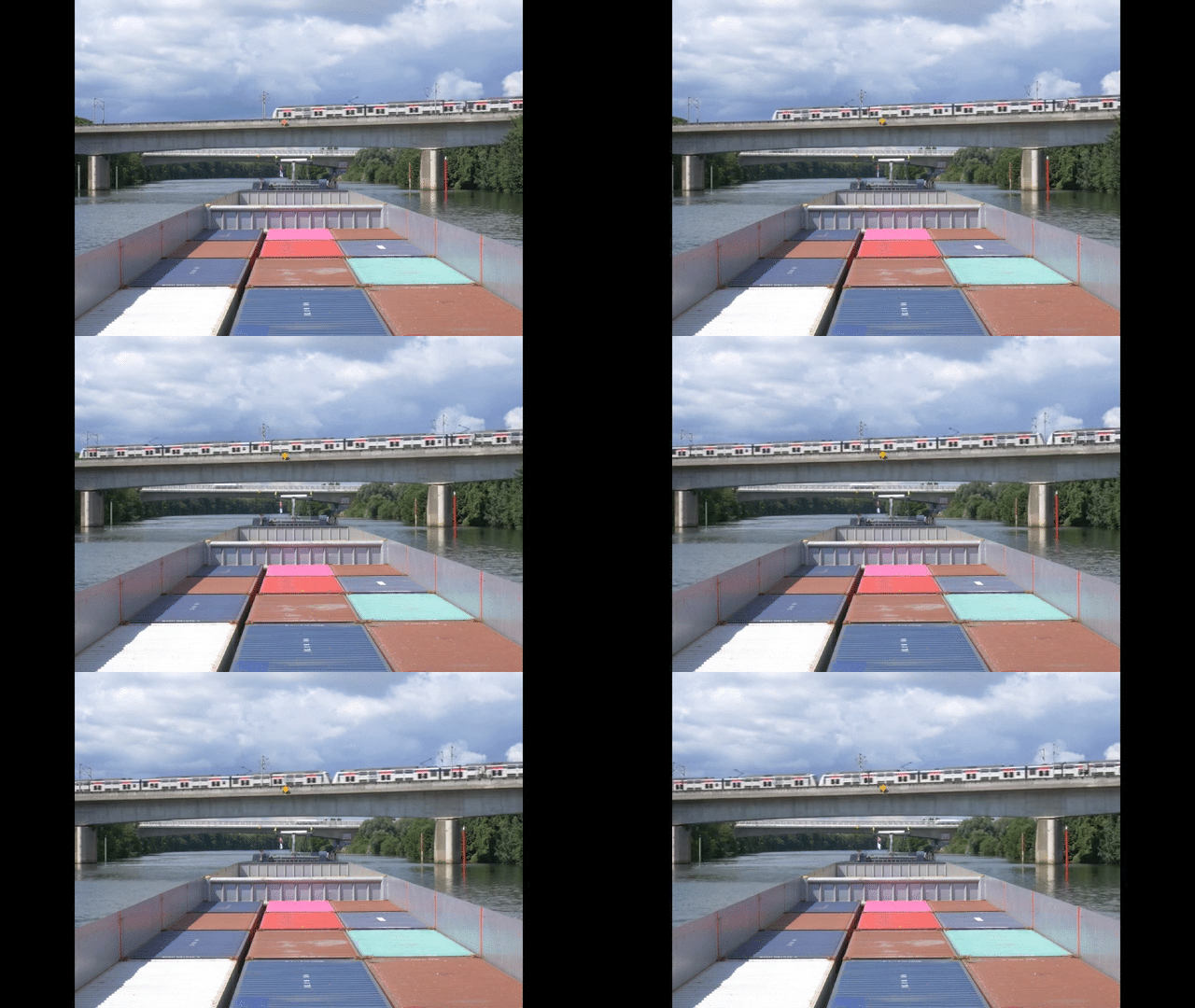
UK Chatterley Whitfield, Stoke-on-Trent This dance-poetry-film comes out of an Arts and Humanities Research Council project on Quebec's Eastern Townships and l'Estrie. It is a response to an audio-walk set in Magog, a lakeside town, tourist destination, and site of a former textiles factory - a trace of the region's industrial past that is little known outside it. The walk considers literature, geography, and history, and includes creative prompts for participants to try if they so wish. Choreographer, Clare Reynolds, responded to the walk with this solo danced by Patsy Browne-Hope, which brings together Magog's deindustrialised landscapes with Reynold's home city of Stoke-on-Trent. 'Heartlands: Earth & Bones' is part of a literary geographies and participatory geohumanities project, entitled 'Heartlands/Pays du coeur: Geohumanities and Quebec's “regional” fiction’. Ceri Morgan (PI) drew on desk-based research on C21 fiction and creative nonfiction (in English and French) set in Quebec's Eastern Townships and l'Estrie to script an audio-walk (in English, also translated into French). Located in Magog, the route of the lakeside walk is partly symbolic, in that whilst elements are site-responsive, others make reference to elsewhere in the Townships/l'Estrie. The walk offers an insight into the region's literature, geography, and history, and includes creative prompts. Prior to publication, Morgan trialled the audio-walk with other artists and community members, making modifications in response to feedback. Reynolds participated in the second trial, drawing on it to choreograph the dance solo performed in the film. Paul Rogerson also participated in the trial, going on to compose the film's music. Morgan wrote the poem used in the film's soundtrack following a participatory activity involving undertaking the walk around a lake on Keele campus (in psychogeographic fashion). She performed a draft version of 'Wrinkled Skin' at an informal public reading event to mark the close of the project. Exploring themes of bodily responses to place/s, site-responsive creative practices, interconnections between places, interrelationships between the human and other-than-human, the expansion of literary studies.


Heartlands: Earth and Bones

Mientras Todo Iba Pasando
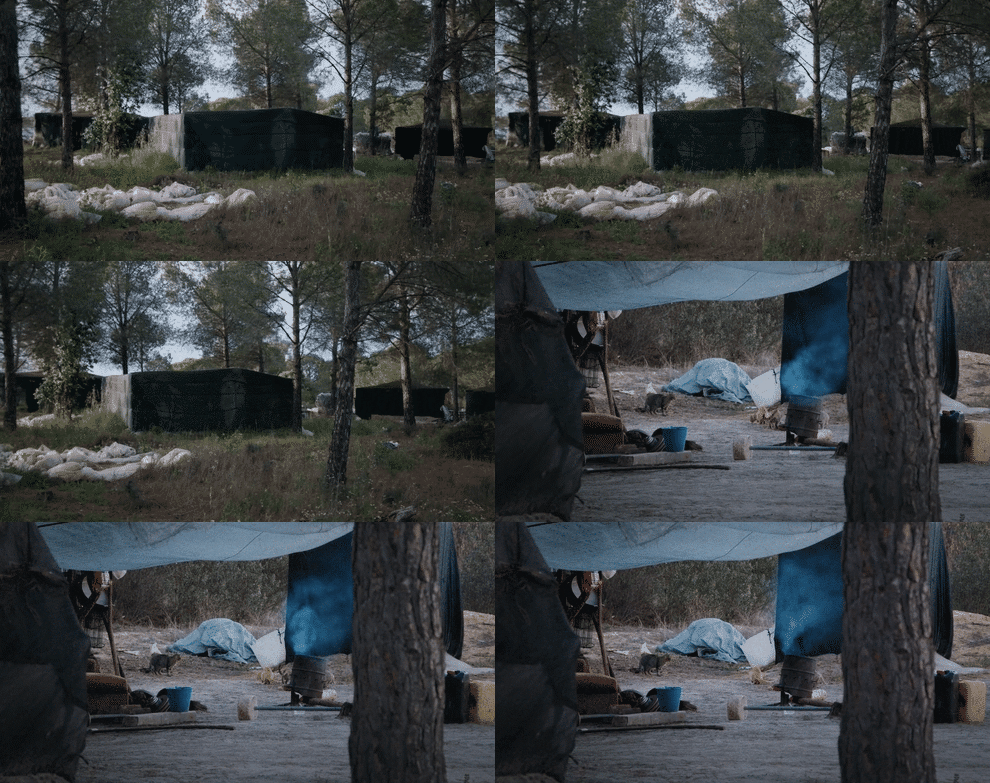
Spanish with English Subtitles UK (Exeter) Peru Mientras todo iba pasando (While it was all happening) is a short documentary film that follows a young Peruvian woman as she recounts her experiences of supporting friends to access abortions. In Peru, abortion is illegal in almost every single circumstance and so this film seeks to explore the experiences of navigating clandestinity and trying to create safety and care in a context that actively criminalizes abortion. The film explores the ethics of what can and cannot be said and purposefully avoids telling a simple story of abortion access. The film set out to explore geographies of abortion care in a context than criminalizes it. This involved documenting the stories of people who have accompanied abortions, showcasing how their traditionally overlooked role as ‘acompañantes’ [accompaniers] is pivotal in providing care and reducing damage for people who undergo abortion procedures. By following these stories, the film also explores clandestinity as a space that simultaneously endangers people who seek abortions and allows for the emergence of infrastructures of care. As the project progressed, the team grappled with the ethical implications of making these hidden experiences public through the documentary. This led to an exploration of the ethics of making a documentary about activities on the fringes of legality and the accompanying silenced stories. The project had three aims: 1.    To document the stories of people who have accompanied abortions in the context of criminalization and stigma in Peru 2.    To film these stories and produce a documentary film 3.    To share the documentary as a resource to raise awareness of abortion care in Peru, and to contribute to the elimination of stigma

Mientras Todo Iba Pasando

Spectral Index
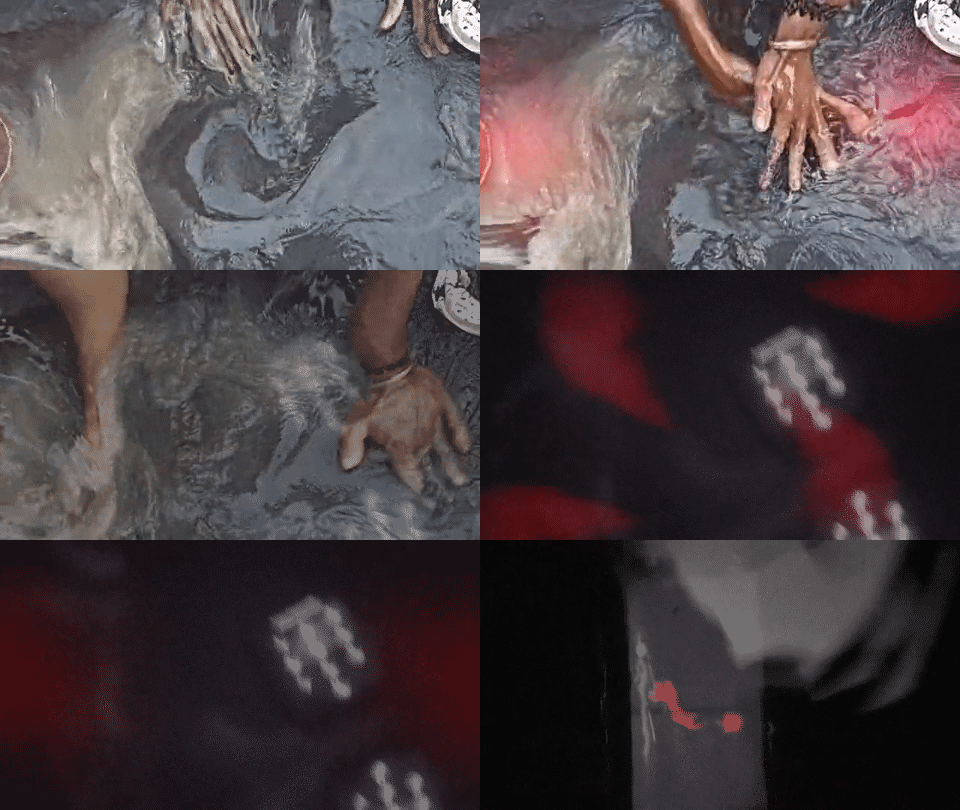
UK Norway, Austria, Chile A ‘spectral index’ is a mathematical image calculation that renders its subject in false colour. In geological prospecting it is used to identify mineral deposits: a technique of mapping terrain for monetary gain. Combining satellite timelapses with infrared drone footage of lithium prospecting sites, and microscope imagery of damaged camera parts, the film considers how this spectral gaze frames our relationship with landscape, both presuming ownership and assuming its future purpose. Mapping has always been a means of circumscribing property, but in the technics of spectral prospecting, the calculation of chromatic values connects directly with a calculation of financial value. The film was developed following a yearlong collaboration with the Horizon EU research project GREENPEG, who were prospecting for lithium-bearing pegmatites within Europe. During this period, I travelled with the consortium's geophysicists to Norway, Ireland and Austria documenting their work and discussing the techniques they used. In my own studio meanwhile I produced satellite timelapses of the landscapes surrounding copper and lithium mines in Northern Chile, and shot microscope footage of damaged camera sensors. While the time spent with GREENPEG generated a lot of footage, very little of it is used in the final film. During the research process it became apparent to me that I was both highly critical of many of the assumptions that are baked into energy transition, and that my interest was in the planetary scale of the problem. Making a documentary style film about a single scientific project would have failed to address this scale, and unjustly targeted the critique at scientists whose motivations are fair. Spectral Index therefore focuses on the systemic aspects of the imaging techniques used, and the profitability calculation that they enable.

Spectral Index