Spectral Index
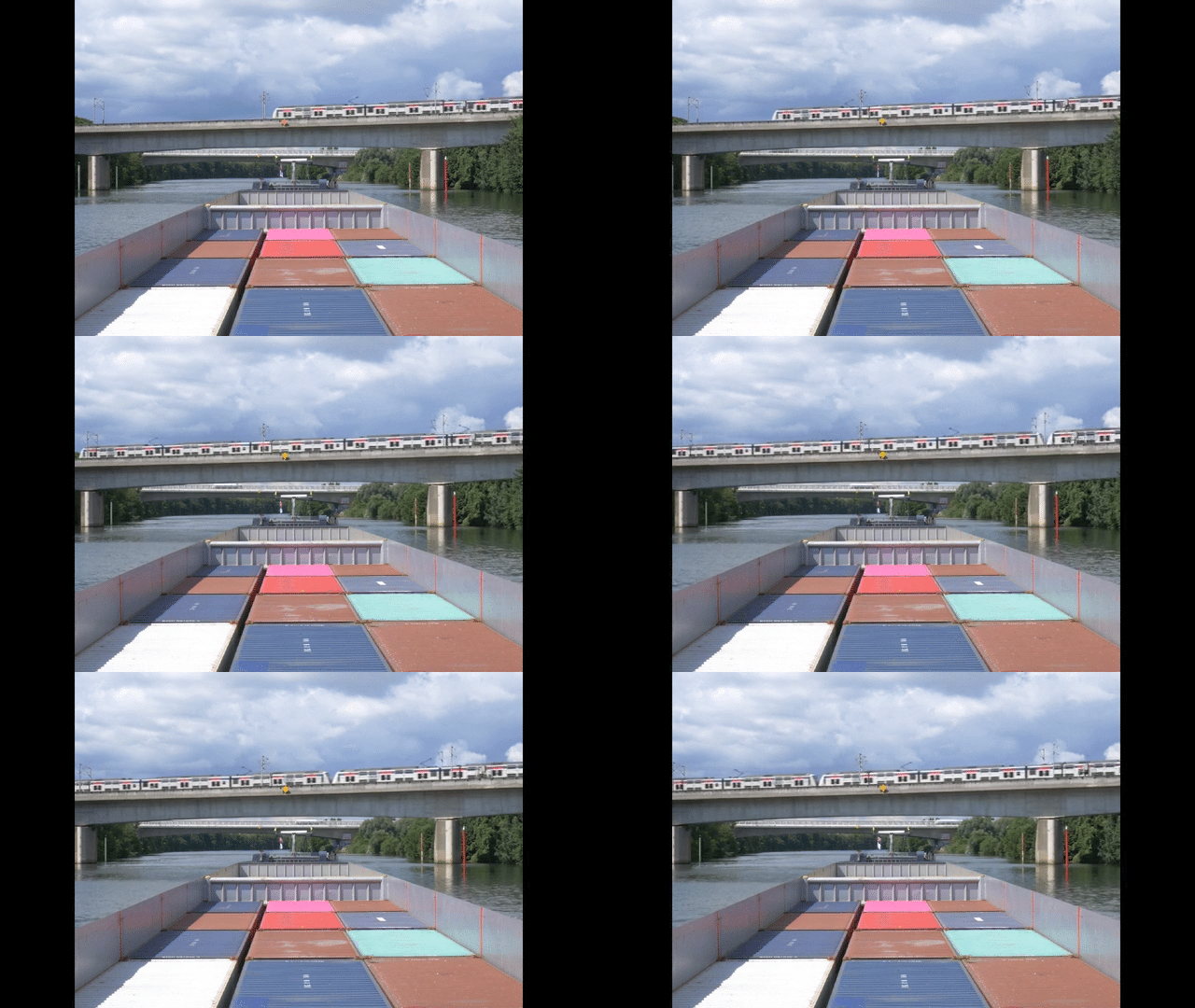
UK Norway, Austria, Chile A ‘spectral index’ is a mathematical image calculation that renders its subject in false colour. In geological prospecting it is used to identify mineral deposits: a technique of mapping terrain for monetary gain. Combining satellite timelapses with infrared drone footage of lithium prospecting sites, and microscope imagery of damaged camera parts, the film considers how this spectral gaze frames our relationship with landscape, both presuming ownership and assuming its future purpose. Mapping has always been a means of circumscribing property, but in the technics of spectral prospecting, the calculation of chromatic values connects directly with a calculation of financial value. The film was developed following a yearlong collaboration with the Horizon EU research project GREENPEG, who were prospecting for lithium-bearing pegmatites within Europe. During this period, I travelled with the consortium's geophysicists to Norway, Ireland and Austria documenting their work and discussing the techniques they used. In my own studio meanwhile I produced satellite timelapses of the landscapes surrounding copper and lithium mines in Northern Chile, and shot microscope footage of damaged camera sensors. While the time spent with GREENPEG generated a lot of footage, very little of it is used in the final film. During the research process it became apparent to me that I was both highly critical of many of the assumptions that are baked into energy transition, and that my interest was in the planetary scale of the problem. Making a documentary style film about a single scientific project would have failed to address this scale, and unjustly targeted the critique at scientists whose motivations are fair. Spectral Index therefore focuses on the systemic aspects of the imaging techniques used, and the profitability calculation that they enable.

Spectral Index

Literate
Nepal Nepali with English subtitles Three Nepali siblings from the village document their new lives as city dwelling, young adults. "After making two films about the Darnal family—Drawing the Tiger (2015) and The Eldest Son (2017)—the filmmakers recognized the curiosity of the Darnal teenagers to be behind the camera and document their own lives. Literate is a collaborative, experimental documentary with Sarita, Rashmita and Ram Kumar Darnal as the directors of photography. The film has been edited from their footage, shot over two years. It is a piece still in process, part of a larger, ever-evolving project of documenting the Darnals’ lives over the past decade. Though making documentaries has become more accessible than ever, we recognize that doing so has essentially remained an art of the privileged. Since we started filming the Darnal family in 2008, our films have been part of a deepening and increasingly urgent conversation about whose story is being told, and by whom. ‘Subject,’ ‘character,’ ‘protagonist,’ ‘participant,’ ‘collaborator’—all are used to describe those who appear in a documentary—but to varying degrees, all center the gaze of the producers. We have interviewed Sarita, Rashmita and Ram Kumar about growing up in the village, their education, how they see their futures. We captured and controlled their stories via our western, documentary and narrative lenses. After having pointed cameras at them for many years, we wanted to know what they would choose to show of their own lives. Literate is an exploration of how the Darnals express themselves from behind the lens. Literate does not follow a story arc, but is a collection of images from three young Nepalis during a huge transition in their lives—leaving their village to come to the city as the first in their family to read and write. What do they see? What do they want to say? We have known Sarita, Rashmita and Ram Kumar Darnal since 2011, when they were small children. They participated in two of our previous films, which focused on their older sister and brother. While in production on these projects, the younger kids would pick up our cameras and shoot around the village with their friends. We loved finding these images among our footage. It was like behind-the-scenes from our documentarian presence. Spurred by Nepal’s earthquake, the Darnal family made the decision to move to Kathmandu in 2017. It was at this time the three siblings, now young adults, expressed interest in filming their new lives as city dwellers. We applied for a grant to purchase cameras. The cinematographer on our two previous projects, Shailendra Karki, created a camera training course for them. Our instructions for Sarita, Rashmita and Ram Kumar were the following: Turn on and point the camera when and in the direction you feel compelled; to show the story you want to tell. We then braided their footage together. We are submitting this as a Work-in-Progress due to the project being stalled by the pandemic. We will incorporate more of their commentary in its next rendition. From our ‘fly on the wall’ footage during our previous films with the Darnals, it was not uncommon for a mic’d family member to reflect upon us and our experience: “Why does Amy want to film me do the dishes again? She must be bored. I hope she is not too hungry and hot in the sun.” Although we did not appear on camera, we, the filmmakers, were very much part of the films. When we received the Darnal siblings’ footage via a DHL package in Seattle, it was like Christmas morning. To watch each file was thrilling—to see what they chose to focus on. Ram Kumar witnessing electricity’s arrival in the village of his childhood. Sarita and Rashmita, inseparable sisters, free for the first time as young women going to school in Kathmandu. After watching Literate, all three cinematographers reported feeling the film is not yet complete. They loved filming and felt it empowering. They would like to film more, especially if it could be a paid job. (They did receive a stipend for their participation in this project.) The blocking issue is their very busy lives. Ram Kumar and Rashmita work six long days a week and have only Saturdays to do their housework. Sarita is now married and is newly a mother. Our experience of exploring cultural geography is from a documentary film lens. Our plan is to continue this project with the next step of including the Darnal siblings in the editing process. This to us would be a further dive into this film collaboration. How would they arrange and now comment on the scenes they filmed? What would they say about this footage now that they are older, post-pandemic and calling Kathmandu home?"

Literate

To Belong
Nepali Nepal Kumar Darnal, a Nepali metal worker and farmer reckons with his choice to convert from Hinduism to Christianity in the hopes of shedding his caste: What he has gained, lost, and how becoming Christian has affected his social standing and personal safety. Kumar Darnal, along with his family, has suffered from discrimination their whole lives because of their Dalit status. His family went without food because Hindus from a higher caste refused to pay them for metal working services with the excuse that the days were auspicious. Hurt and anger live in Kumar’s memory from when he was a boy and a shopkeeper forced him to kiss his feet after he accidently touched the man’s shoe. Kumar moved to Kathmandu at 13 in hopes of earning money to send home and to escape his low station only to find more economic and emotional harm after numerous landlords raised his rent after learning his last name. Feeling alienated by his Hindu community, Kumar accepts an invitation to go to church from a neighbor. He and his family convert shortly afterwards. In Nepal in 2021, the conservative RPP party marched in the streets for the return to a purely Hindu state. Neighboring India declared Dalits who have converted to Christianity no longer have the right to government subsidies or affirmative action programs. To Belong is an intimate reflection on Kumar Darnal’s decision to convert to Christianity, and asks if it has improved his life. "Despite the limitations for filming due to the pandemic, the film unearths the complexity of disappointment Kumar is experiencing after converting. He finds that neither religion, Hinduism or Christianity, has provided the opportunities he had hoped. Both entities want something from him, rather than a place for him to grow and connect with others. While he still attends church on occasion, his search for belonging continues. Kumar found the process of making the film a key component for survival during the strict lockdown in Nepal during COVID. It not only provided income in a desperate time but it was a way of processing the trauma he has suffered due his poverty and Dalit status. Kumar continues to film video diaries of himself as a way of processing his feelings of discrimination. He shares them with us for a future documentary project. Video is our method of exploring social and cultural geographical topics in Nepal. Our ongoing collaboration with the Darnal family as filmmakers explores the switching up of authorship, focusing on process and relationship rather than product."

To Belong

Maalik
Hunza Valley and Kech Pakistan Balochi with English subtitles The film shows how the filmmaker is pre-occupied in his subconscious, he is constantly entangled with thoughts of his identity in addition to the circumstances he is living in. As film progress he goes home, to seek peace. The film is a documentary, fictionalized by following the cinematic tradition of filmmakers from French new wave like Alain Resnais, Chris Marker and many more. The film's self reflective and self referential nature qualifies it as an essay film. It contextualizes the motif of mountains and barren land in very new and fresh way. The visual and the sound is dialectically juxtaposed for the subject who finds peace in the unrest and restlessness in a peaceful place. The film is visually divided into two parts, initially filmmaker where he is struggling to attain peace in mountains. Overall, composition of the frame is very dynamic. Whereas the framing in the end portion is completely different, almost opposite of it. In sound design, gunshots were added to enhance the mental disturbance of the filmmaker. The goal of the film was to show how human beings are being normalised into conditions which are not appropriate to live in. The conflict of sub conscious and existing reality of filmmaker about where he belongs. "I think experimental film making was key point for me to work on this project and its techniques. When I was filming in my hometown, security threats were something which made me think twice before opening my camera to shoot. Because we can't openly film there, states operatives always try to impose their narrative and poses a real threat to life for example forced disappearance, and being abducted. These ground realities were highlighted."

Maalik

Woman, Life, Freedom; The Sounds of A Revolution
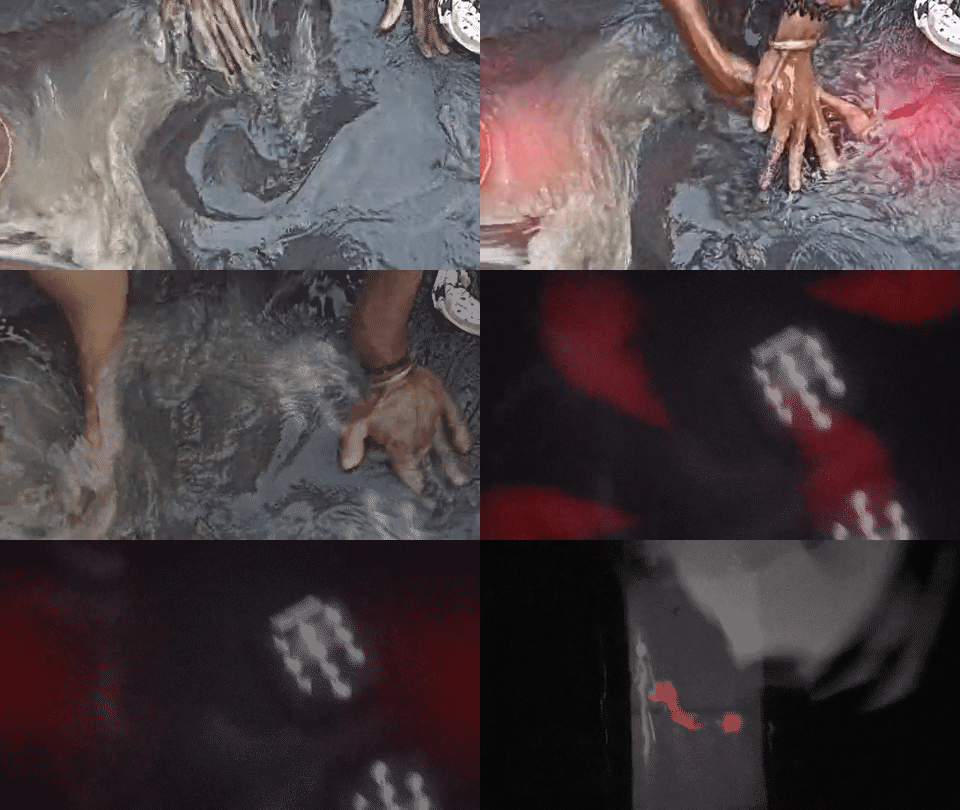
Farsi, Kurdish, Arabic dialect On September 16, 2022, a 22-year-old Kurdish Iranian woman named Jina (Mahsa) Amini died in Tehran, Iran while in the custody of the so-called morality police. Her death has triggered nation-wide protests. This multi-media creative piece, entitled "Woman, Life, Freedom; The Sounds of A Revolution”, tries to depict the Iranian women’s struggle against the establishment of the Iranian regime since the 1979 Islamic Revolution. In so doing, eleven sounds have been extracted from the recordings of the 1979, 2009, 2021 and the 2022 protests, shared on social media from within Iran. The accompanied text situates the sounds within their historic, geographic and political contexts. It is based on data collected from the virtual space. "Through this film, we want to explore the Iranian women’s resistance since 1979. The film is a combination of sounds and texts that show 10 important points in the history of women’s struggle since 1979; starting from International Women’s Day march in 1979 against Khomeini’s mandatory hijab decree, 2009 Green Movement (the killing of Neda Agha Soltan that went viral on social media for the first time), 2021 Protest against water shortage (the beating of a female protester), and the rest are based on the 2022 Jina Mahsa Amini protests (the schoolgirls’ protests, the killing of Nika Shakarami, Tehran Metro protest against systematic patriarchy, the Kurdish lullaby of Shouresh Nikanm’s mother, the Chehelom protests in cemeteries, and the singing of female political prisoners in Evin prison). The sounds are part of a bigger archive, collected from the online released videos posted by Iranian protesters on different social media platforms. Sounds are accompanied by texts which provide the context of each episode, taking the audiences into a sensory experience of a revolution they haven’t been part of. They cannot see, but they can hear and feel the fear, anger, rage, and hope. Our project – a multi-layered, critical study of socio-political movements in Iran since the 1979 Islamic Revolution – is based on exploring the geographies of sound, space, politics and feminism. These are the list of our findings: 1) foregrounding the unheard voices of protesters inside Iran through archive methodologies 2) reflecting on the systematic production of inequality, oppressive urban space, non-citizens, and the discrimination against different ethnic, gender and other marginalised groups by the Iranian regime, and 3) constructing a short exploratory sound film from historic and contemporary witness recordings of protest generated and shared via social media. Making this exploratory, creative sound film is helping audience to imagine the geographies of oppression through sound. The sound technology, coupled with text, added a sensory dimension to the perception of the production of space beyond the visual dimensions. Audiences cannot see but they can read and hear. They read the exact date and location of the happenings and a brief reflection on the context, then they can hear the voices. Through this film, the audience, who is located in different parts of the world, is now familiar with the diverse geographies of protest in Iran. The main challenge we encounter however, was to find the right method for categorising the videoclips. The video clips were added on the social media platforms on an unprecedented speed. To give a context, the Farsi version of Mahsa Amini name for instance, #mahsaamini, twitted more than 274 million times in 24 days after her death. In so doing, we divided the video clips into two main categories of individual struggle of women and collective protests of people, so in this way we could shed light on both the oppression and resistance at the same time."

Woman, Life, Freedom; The Sounds of A Revolution

Groundkeepers
Stoke on Trent, UK English The headstocks of a disused colliery are stilled and quiet but the stories they tell continue to resonate. Created in response to an Artists' Tour, led by the Friends of Chatterley Whitfield and Urban Wilderness in patnership with Keele University. Former employees guided the tour and gave an emotive background to life and work within its boundaries. The site is now protected as a Scheduled Ancient Monument. The film draws comparisons between the stoic image of the headstocks left to stand watch, and the role of the volunteers who continue to tend the site and support the interpretation of its heritage. The poem is read by the filmmaker's grandfather, a native of a mining town in North Nottinghamshire. His voice reflects the overlap in accents and dialect found between mining communities across the Midlands. The film set out to explore poetry film as a medium for engaging with place. It considers how taking time to pause in a place can affect our relationship to it, and deepen our sense of connection. "I found that taking the time to interact closely with a specific location enabled me to forge deeper connections with that place, and to respond creatively in a way that sought connections between the traces of the past and the detail of the present. I found that following instinct and allowing the process to develop organically resulted in a piece that was led by the place interaction, rather than being dictated by preconceived ideas. And that the process of pulling together the audiovisuals with poetic ideas in the editing suite generated new creative ideas and a lasting connection to the place encountered." The film forms part of a collection entitled 'PAUSE', which examines the ways in which we connect to place, and how taking time to pause can impact on those connections. Created as part of practice-led PhD at Keele University in partnership with Writing West Midlands, with additional supervision from staff at the Centre for Place Writing at Manchester Metropolitan University. This research is supported by the North West Consortium Doctoral Training Partnership, part of the Arts and Humanities Research Council.

Groundkeepers

Putting the Flesh on the Boneyard
Tuscon, Arizona, USA It is a surreal scene in the Sonoran Desert: rows and rows of old military aircraft, baking in heat and dust. Welcome to the “Boneyard”, one of the largest collections of old aircraft left over from decades of U.S. airpower and warfare around the world. This large site is located inside the Davis-Monthan Air Force Base, an active base on the outskirts of Tucson, Arizona (USA), and is where old aircraft go when their time patrolling the skies of the world comes to an end. Over 4,000 aircraft are housed there, making it one of the largest facilities of its kind. The fieldwork film is part of a project that looks at violence of the military meets everyday civilian life directly, making them intriguing laboratories for understanding everyday militarism. It builds on military geographies and borrows Rachel Woodward’s (2005) definition of a “critical military geography… which seeks to understand how life in the civilian sphere is shaped by military structures and imperatives” (as summarised by Bernazzoli and Flint 2009, p. 393). "It may seem a stretch to be suggesting that these military museums cause slow violence, which is typically associated with the real embodied suffering of those impacted by environmental racism and other infrastructural conditions. Because of the specific nature of this military infrastructure, one that straddles military and civilian geographies, given the auto-ethnographic work and observations at large, we are compelled to make a linkage between slow violence and epistemic violence, as the later has been elaborated on in the context of museum politics (Tolia-Kelly 2019)This particular form of epistemic violence resembles slow violence, then, we suggest as real harms are distributed as a result. In an infrastructural scenario like the military museum, we must consider these as gaining force from each other."

Putting the Flesh on the Boneyard

Harbouring Illness
London, UK "Harbouring Illness" is a portrait of three women living with long-term health conditions in an East London neighbourhood. Through their stories, the film offers insight into the everyday challenges of living with chronic illness amidst an overstretched and underfunded healthcare system. It delves into the effects of social isolation and the struggles that come with maintaining a healthy life in the face of substandard living conditions. "Harbouring Illness" invites the viewer to contemplate new possibilities for living a flourishing life beyond the confines of conventional medical understandings of health and well-being. "Multimorbidity, commonly defined as the co-occurrence of two or more long-term health conditions, is considered a major challenge to contemporary care services. Why multimorbidity poses such a challenge and what kind of challenge it is, is not straightforward. In the short documentary "Harbouring Illness" I explore the experiences of working-age adults living with multimorbidity in a socio-economically deprived borough in London. Starting from a photography project, I involved three study participants in the production of this film. In particular, we explore the effects of social isolation and the struggles that come with maintaining a healthy life in the face of substandard living conditions. I found that taking the time to interact closely with a specific location enabled me to forge deeper connections with that place, and to respond creatively in a way that sought connections between the traces of the past and the detail of the present. I found that following instinct and allowing the process to develop organically resulted in a piece that was led by the place interaction, rather than being dictated by preconceived ideas. And that the process of pulling together the audiovisuals with poetic ideas in the editing suite generated new creative ideas and a lasting connection to the place encountered."

Harbouring Illness

From the Culch
Cornwall UK English Sound Kingsley Marshall This film is assembled from the 16mm bin cuts of a long lost 1978 BBC documentary about the Truro River Oyster Fishery in Cornwall, where ancient laws required dredges to be hand-pulled over the fishery under sail – the only regulated sail-powered fishery in the UK. After the documentary was broadcast a can of randomly assembled 16mm film was given to Dennis Laity, crewman on the working boat George Glasson, as a memory of his late brother Paul, who passed away not long after the original shoot wrapped. The can of film lay in Dennis’s airing cupboard for 45 years, unseen, before being passed to the director, who lives in the same Cornish fishing village and works as a filmmaker at Falmouth University. A 4K digital scan revealed the beauty captured in the celluloid and Dennis, now 82 years old, gave voice to his memories of the men who dredged the oyster beds of the Carrick Roads and the boats they sailed on. A story emerged – of a very specific place and working methods, and of love and loss, time and memory, dog biscuits and sideburns – these discarded bin cuts growing into this contemporary retelling of a fishery fished by Cornish families in gaff-rigged boats for over 100 years. The culch is the bed on which oysters grow. Composed of discarded shells, stones and grit – thrown overboard once the dredge has been sifted for marketable oysters – the culch is the fertile ground on which future harvests rely. Bin cuts are the bed on which this film has grown. Composed of discarded shots, retakes and tails – thrown on the cutting room floor once the edit has been sifted for marketable material – bin cuts are the fertile ground on which archival documentaries can flourish. The filmmakers propose that once discarded moments of aesthetically and narratively undesirable footage are in fact a more fitting container for emotion and memory than the carefully staged and framed footage more common to broadcast documentary. Their production process was in itself was cathartic and deeply moving, and considered how film is impacted by a desire to remain true to the memory of people, language and place. The filmmakers followed a technique used by Adam Curtis (Hypernormalisation, Bitter Lack) in their editing decisions, in sound design and score, in interview technique and writing – sought to honour the material, retaining the sense of discovery that comes from opening a can of film whose contents are deemed valueless to some, yet are priceless to others.

From the Culch

Beyond Money: Yenomon
Central Victoria Australia, Europe and US Is money responsible for current socio-economic inequities and ecological unsustainability? How might a postcapitalist imaginary address and resolve the socio-economic and political inequities and ecological unsustainabilities of capitalist relations of production based, as they are, on monetary calculations and relations? What might a postcapitalist world without money feel and look like? How might it operate? The film draws on scholarly research to give life to a degrowth, eco-socialist and nonmarket socialist community mode of production of the future. "Film making is generally an expensive and highly technical process, with many (mainly male) collaborators using lots of material and energy in production, marketing and distribution. In line with the content of the film, I chose as simple, easy, at hand and inexpensive ways of proceeding. The whole project except for the soundtrack was made by talented women living within 15 km of where I live. I wanted the film to have a creative flair and be constructive. It needed to be concise and then made as freely available as possible. My findings from screenings in conferences through to small gatherings, indicates that audio-visual communication is a relatively successful way to introduce complicated topics to a range of people and to enable common ground on which to engage with them. At the same time, the simplicity and summary nature of the project has led to certain misconceptions about the sophistications of a community mode of production. Where there is common space for viewers to raise queries with me they can be addressed. In general, employing my film making skills as a form of communication has proved a successful way to convey my ideas and, screened in forums, it has formed common ground on which to discuss really different futures." The filmmakers acknowledge the Dja Dja Wurrung people as the Traditional Owners of the land on which this short film was produced.

Beyond Money: Yenomon

Spiritual Flavours
London, UK Spiritual Flavours interweaves biographical narratives and spiritual accounts from Betty, Aziz and Ossie (who belong to a Catholic church, a mosque and a liberal synagogue, respectively) with the experiences of cooking in their homes in Ealing, London. The recipes thread narratives of past, present and future aspirations, spirituality and the everyday. Their commonalities and differences are expressed through visual and sonic synchronies and asynchronies. Also, by overlapping soundscapes of cooking and praying, the film develops a rhythmic and affective experience of the relationship between food and religious practices. At the end, Betty, Aziz and Ossie meet, cook and eat together. "This film is part of my interdisciplinary doctoral research "Spiritual Flavours: Reflections on using creative practice to explore food and religion in a multi-faith suburb" (2022). This investigates the relationship between food and religious material practices of several faith communities in Ealing, a suburb in West London, selected to represent different faith and migration traditions. These include a Synagogue, a Sri Lankan Hindu Temple, a mosque, a Sikh Gurdwara, an Anglican church, a Roman Catholic church and an ethnically diverse Pentecostal church. The research developed an arts project, Spiritual Flavours, which comprises a photographic series, a film (5' and 28'), and an artist cookbook. Whilst the photographic series uses a formal approach, devoid of people, to explore the spatial arrangements of commensality within religious buildings, the cookbook and the film focus on participatory engagement and biographical narratives. These bring together a diverse range of intimate experiences of food and spirituality across both domestic and worship spaces, and expose the nuanced ways in which faith, age, gender, identity, migration, community and home intersect. The film also produces a rhythmic and multi-sensory experience through the use of the split-screen technique and the creative mixing of sounds of cooking and prayer." More information available at www.spiritualflavours.com.

Spiritual Flavours

Skopje 2014 According to ChatGPT
Skopje, North Maceodnia Exploring the synergy between artificial intelligence, the internet, and urban metamorphosis, this project intricately unravels the transformation of a city. It examines the complex dynamics at play within urbanism, architecture, and nationalist revitalization, revealing the role of social media and AI in deciphering how the internet perceives the controversial Skopje 2014 project. This film aims to unravel the complex dynamics surrounding Skopje's controversial Skopje 2014 project through an immersive multimedia experience. Blending urban research, personal narratives, and inventive digital storytelling techniques, the film explores how this government-led urban renewal initiative promoted a homogenised Macedonian-Slavic-Orthodox identity by radically transforming the cityscape. It investigates Skopje as a palimpsest, a mixed-ethnic city where layers of contested history, culture, and belonging have been repeatedly inscribed and erased. Moving beyond the architectural transformations, the film illuminates the broader existential struggle faced by cities striving to build a unified identity against the centrifugal forces of globalisation and competing local allegiances. Skopje's erasure of its Yugoslav past also surfaces questions of constructed heritage and invented tradition in the process of nation building. Through this, it aims to explore how the internet remembers Skopje, but most importantly, how AI understands it. "This film extensively utilises AI systems like ChatGPT to conduct research and craft the narrative structure. ChatGPT serves as a creative interlocutor, helping formulate critical questions about Skopje 2014's impacts that shape the film's direction. Generative image tools like Midjourney are used to visualise different conceptualisations of the city. The AI generates photorealistic impressions of Skopje based on textual prompts, encapsulating imagined realities. These AI-created scenes add speculative layers to the documentary's exploration of the city's complex identity. By blending AI-assisted research, generative media, data visualisation, and cinematic storytelling, the film provides multidimensional perspectives on Skopje 2014. The AI elements enhance the narrative while retaining a humanistic approach to the subject matter. Through extensive on-the-ground research and innovative digital storytelling techniques, this project illuminated the complex dynamics surrounding Skopje 2014. The film's immersive visualisations and AI-powered narrative revealed how the government-dictated remaking of Skopje promoted a narrow Macedonian-Slavic heritage while erasing the city's multiethnic fabric and Yugoslav past. The film's use of social media discourse also unearthed more mainstream narratives. Ultimately, the project provided a polyvocal, multilayered record of this controversial urban planning initiative through an immersive experience. The creative use of emerging technologies fundamentally expanded the possibilities of the documentary form. Tools like geospatial analysis, AI, and interactive storytelling enabled a more participatory, nonlinear mode of nonfiction filmmaking. The ability to incorporate speculative and counterfactual dimensions opened up new avenues for exploring the past and future ramifications of Skopje 2014. However, crafting a cohesive narrative from these multifaceted streams of data remained an ongoing challenge. The film required finding the right balance between technological innovation and human storytelling. Still, it demonstrated how computational documentary can reveal new dimensions of complex urban issues and create more affecting, insightful experiences for audiences."

Skopje 2014 According to ChatGPT

Crossing Paths
Shropshire, England and Powys, Wales On the border of England and Wales, two ancient pathways cross. Their stories emerge through poetry and song. In this poetry film, the Kerry Ridgeway takes on the character of a lovelorn maiden. The Offa's Dyke Path is explored as a site of repeated movement of people and livestock over time, carving out ditches, hollows and histories. The film plays upon conventions of hauntology within folk music, poetry and folk horror cinema. "The film set out to explore poetry film as a medium for engaging with place. It considers how taking time to pause in a place can affect our relationship to it, and deepen our sense of connection. I found that taking the time to interact closely with a specific location enabled me to forge deeper connections with that place, and to respond creatively in a way that sought connections between the traces of the past and the detail of the present. I found that following instinct and allowing the process to develop organically resulted in a piece that was led by the place interaction, rather than being dictated by preconceived ideas. And that the process of pulling together the audiovisuals with poetic ideas in the editing suite generated new creative ideas and a lasting connection to the place encountered." This poetry film forms part of a collection entitled 'PAUSE', which examines the ways in which we connect to place, and how taking time to pause can impact on those connections. Created as part of practice-led PhD at Keele University in partnership with Writing West Midlands, with additional supervision from staff at the Centre for Place Writing at Manchester Metropolitan University. This research is supported by the North West Consortium Doctoral Training Partnership, part of the Arts and Humanities Research Council.

Crossing Paths

A ‘Dash of Home’
Te Whanganui-a-Tara Wellington, New Zealand A ‘Dash of Home’ participates in the settler-colonial practices of seeing Indigenous land through European image-making practices. Drawing from historical colonial images of Te Whanganui-a-Tara Wellington in Aotearoa New Zealand, the film disrupts the English settler’s drive to see a ‘dash from Home’ in colonial images. The film co-opts colonial image-making strategies by introducing more-than-representational materials into the space of drawing. A ‘Dash of Home’ offers a critical engagement with colonial imagery that gives historical images immediacy, emphasising the material impact of historical representations on the past, present and future. A ‘Dash of Home’ participates in the settler-colonial practice of contemplating Indigenous land as European landscape. Lifted from the publication English Reaction to the New Zealand Landscape, the phrase ‘dash from Home’ describes the strategy of portraying Aotearoa New Zealand, through the landscape preferences of future setters. A ‘Dash of Home’ foregrounds the collective and iterative processes in which colonial images are made. Botanical illustrations from James Cook’s first voyage, town plans and ‘on the spot’ views of Te Whanganui-a-Tara Wellington, produced by the New Zealand Company, were drawn and re-drawn, passing through different hands, changing mediums, and travelling between different lands. Each re-drawing presented the physical aspects of the land but, more significantly, heightened the drawings’ affective qualities, becoming a vehicle for ongoing colonisation. This film seeks ways of altering the ‘dash of home’ mentality through simple and literal moves of adding and extracting materiality within the fictional space of the drawing. A ‘Dash of Home’ continues the tradition of adding the familiar to an unknowable land but equally explores what conceptions of home must first efface before contemplation can take place. "After making the film, I began to reflect on the commonalities between the different representations shown in the work: botany, town plans and landscape scenes. This led to the eighteenth and nineteenth-century practice of scientific illustration called ‘truth-to-nature.’ Scientists and artists collaborated to represent the typical or ideal seen in nature. In the context of my work, truth-to-nature provided a linking mechanism between botany and the more expansive geographical projections, such as landscape plans and perspectives. I began to interpret my work as co-opting or extending truth-to-nature to a broader range of colonial representations. My approach and understanding of ‘truth’ are reimagined in this work. ‘Truth’ in truth-to-nature is not what was physically seen but a kind of contemplative sight. A sight that is distanced from the existing world, allowing new, usually detrimental, ways of seeing. In my work, the idea of ‘truth’ is still emerging. One interpretation is that truth is found in revisiting a specific location’s past and showing that its historical representations have real material effects while offering a mode of inquiry for countering a singular future. Films’ duration, movement and sound offer vitality and immersive affects to our interaction with historical images. For this project, film is a medium that makes the images feel immediate. Film, as opposed to still images, also offered a way to show my participation with the images through time, not fixed in time, as with the source images. One challenge of this project was finding nuance to the tactic of staging colonial image-making strategies while simultaneously countering them."

A ‘Dash of Home’

Stories of Loss and Love
Holy Island, England English This short film-poem (55 sec) was made by Ceri Morgan (prose-poet) and Pawas Bisht (documentary film-maker) last summer as part of a project led by Bisht entitled, 'Participatory Storytelling and Arts for Inclusive and Transformative Nature Recovery and People-Nature Connection'. The film-poem was made following a site visit to Holy Island with Natural England, and came out of conversations around artistic/knowledge form(s), audience engagement, tensions between place-making and place-safekeeping, and the impact of climate change, including coastal erosion. In the final line, the sea is poised ready to swallow the island like an oyster/pearl. Field notes were made (written, photographs, moving images) during a site visit that was also a participatory activity, featuring discussions with a community group, artists and colleagues working on sustainability and/or environmental history, and Natural England colleagues. Morgan then wrote a word-based prose-poem based on these notes and discussions, which Bisht combined with film footage he took on the day to make a film-poem. The method aimed to explore and experiment with forms that could be both art and criticism/research within geohumanities and environmental humanities. The film-poem appears to be more effective than either the word-poem or the film on their own. It seems accessible in terms of speaking to a broad audience, and viewers have been very moved by it. Challenges were technical ones - how to write a prose-poem that would include an environmental message without 'telling' (something to avoid in creative writing), and how to make the film fit the text (this required extensive editing).

Stories of Loss and Love