Brixton/Brickstone
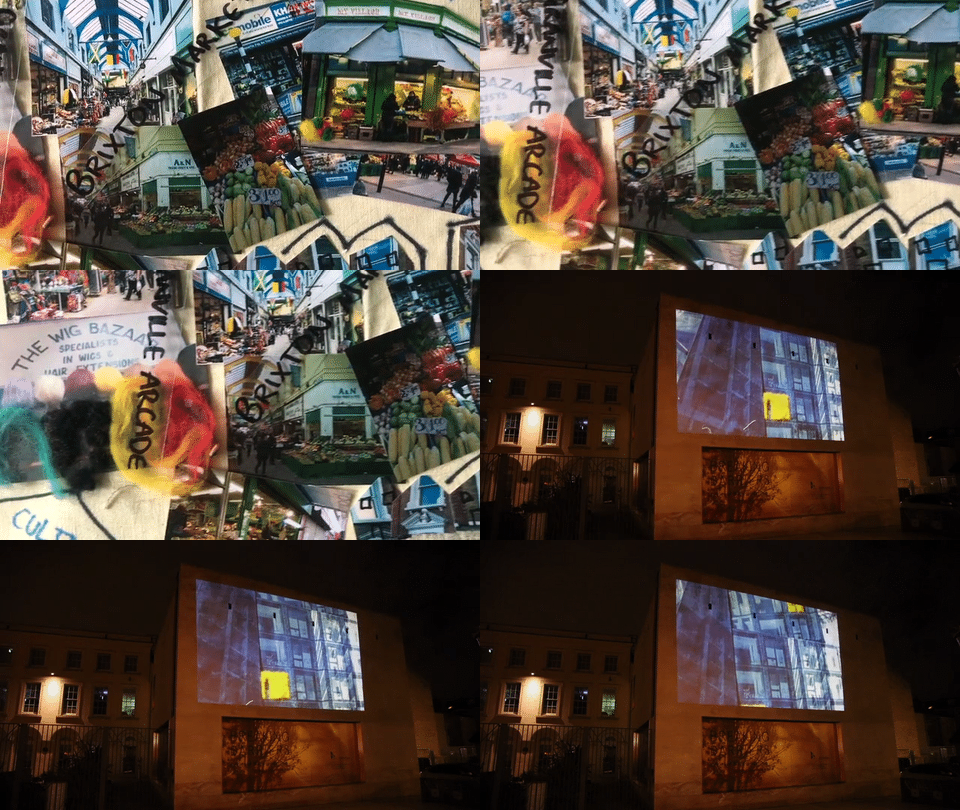
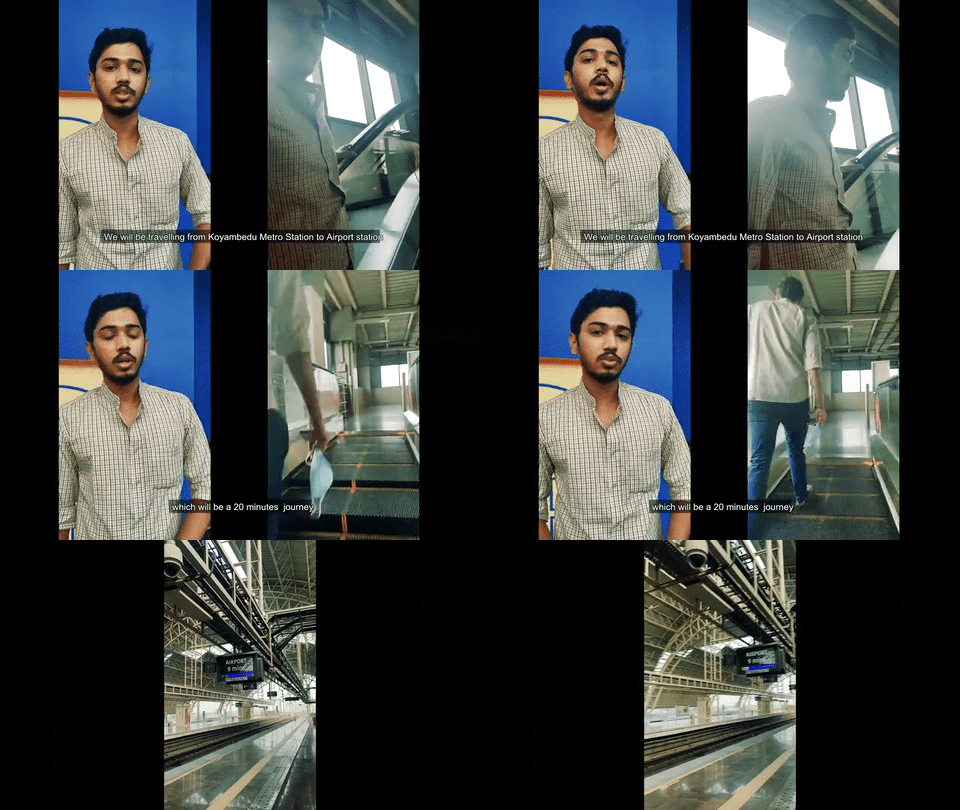
Crafting a community-led regeneration policy “What does home feel like, look like, smell like, sound like?” Words taken from spoken word piece by Grace Deveer, project participant This short film is part of a series of works that explore the challenges posed by regeneration and gentrification for local communities in Brixton. Using an arts-based approach, textile policies were made over four online sessions in July and August in 2020. A mixed media layering of domestic materials and processes, such as embroidery and felting, facilitated conversation and reflection over the hidden and real-life experiences of planning processes. Bespoke ‘collage kits’ were distributed to participants who were introduced to the technique of dry felting which is excellent for 2 and 3D sculpting of ideas. The course also included a session with Photofusion, an independent photography resource centre in the heart of Brixton, covering printing on fabrics. Artists Andrea Morreau and Emily O’Mara (with photographer Ellie Laycock as facilitator and participant) guided the participants through different techniques and ideas for decorating and embellishing the pieces. The next phase saw the works made into a showreel which was then projected onto various iconic Brixton buildings and public spaces. In this way, the intimate and domestic quality of the works was writ large into the public realm in a commentary of how spaces and places become vulnerable to the property development taking place. A final film (above) was then produced from this footage. A forthcoming exhibition at 198 in Railton Road Brixton (Sep 12-16) will include all original material, excerpts from the participants' workbooks, the original handcrafted woollen map of Brixton, a projection of the film, and a chance to write your own community-led housing policy.

Brixton/Brickstone

Posthuman Landscapes
Australia In 2019, we collected ‘B-roll’ footage from three locations in regional Australia during the first year of a three-year research project. During 2020, due to border closures, we were unable to return to complete filming but instead decided to make this short video. Inspired by Linda Lappin’s Soul of Place, we tweet to the landscape. Lappin suggests that in tweeting to landscape, writers should '[l]ook for the beautiful, sublime, picturesque, strange, or comic. Strive for the haiku effect' (p. 43). By combining this with panoramic images, we foreground what would have otherwise been the background while gesturing towards the posthuman. This film was made as part of a three-year project called Engaging Youth in Regional Australia, funded by the Australian Research Council. It was initially planned as a collaborative film-making project that would involve regional youth during 2020. In the first year of the project we travelled to these areas and took preliminary B-roll footage for potential use in the film-making stage of the project which was planned for the following year. Due to border closures in Australia, we were unable to return to these areas and complete the film. Having only B-roll footage presented a challenge as to whether it was possible to make a short video that foregrounded what we had originally intended would only form the background of what would be a human-centred production. We approached the making of the film from a posthuman perspective - one in which the human and non-human are entangled and not separate from one another. Each location in the study is heavily invested in primary production in Australia and so human intervention in the landscape as well as the ability of the landscape to resist these interventions are both evident. We decided aesthetically to use panoramic footage and include a 'text crawl' with a minimal amount of writing that might prompt a posthuman 'reading' of the landscape. Linda Lappin's book, The Soul of Place, provided inspiration for the text as tweets. We reference this with the use of hashtags. We are both creative geographers and have worked in various performative ways in past projects. Candice, especially, has experience in video editing and production but she has never before used B-roll footage in this way. There were many practice-based insights that we gained from being originally immersed in landscape to re-visiting that footage and then responding to it that are difficult to put into words. However, foregrounding the landscape and responding to it in an experimental way resonated with some of the more traditional, qualitative interviews that were conducted with participants as part of the wider project. In particular, the affective and material dimensions of regional youth engagement, whereby young people appreciate and treasure the natural environments in which they live, was something that we more keenly appreciated. Selected Reviews There is no sound as this is originally designed as an installation. There is a rendering of disjointed (posthuman) landscapes: urban environment with transportation, and physical landforms. Accompanied by texts. Could be a useful teaching tool if background is included when shown to students.

Posthuman Landscapes

Mystic Chords of Memory
USA Cymru, Wales Cultural Geographies Mystic Chords of Memory explores how people experience and maintain connections to their shared past and culture in Wales, through different kinds of narratives about place. Principal photography took place in summer of 2019, in geographical regions across the country ranging from the coal valleys of the south to Holy Island in the north. The full length film (in post production) features individuals whose knowledge and experiences include coal and slate mining, land-based art practices, folklore and storytelling, holy wells, sheep farming, local and national history, and environmental stewardship. I had a written my masters thesis on sense of place and place attachment, so those concepts were at the forefront of my thinking when I was developing this film. The idea for the film started with my own familial connection to Wales (where I had never been) through my maternal grandmother, and prompted reflection on different forms of relationships to place. I spent almost two years researching different regions, histories and cultural beliefs in Wales before I started planning the shoot. Most of my participant recruitment was accomplished by joining various Facebook groups, as well as through the wonderful nonprofit, Trec (Folk Development for Wales). Selected Reviews Needs subtitles at times, especially for the first speaker (not the narrator). There certainly is a foundation/core of a film here. The part of the two women (wives) reminiscing remind us that despite much of the hardship and loss (and today’s aversion to coal) this history has a very human and social element and shaped lives beyond the work day. Also, as much as I would like more details about place, I also respect that the film is not focusing on “a history of a place”.

Mystic Chords of Memory

Faces of the Wilderness
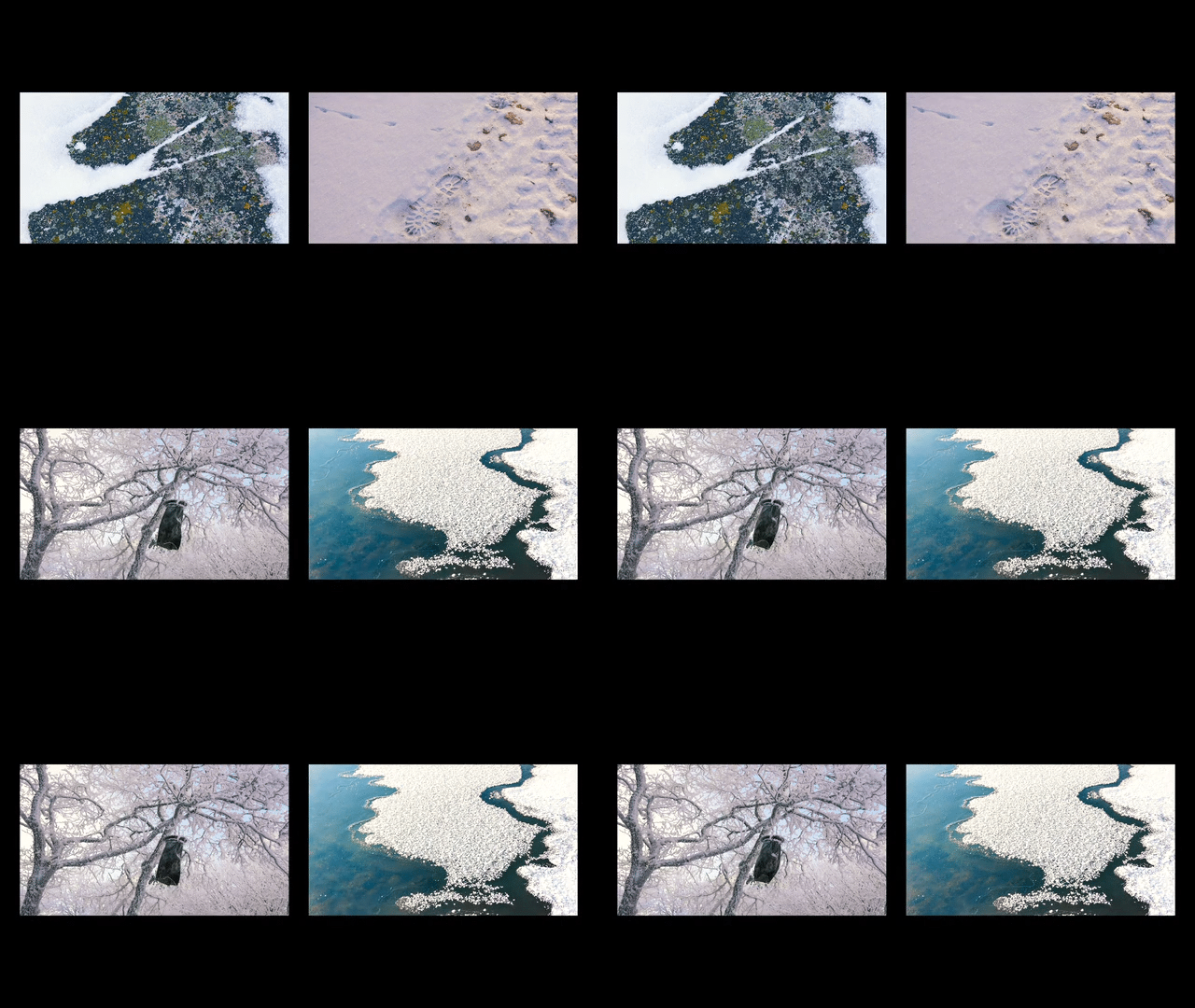
Norway Finnish Lapland English Subtitles Social/Cultural Geography On a road less journey, through the barren lands in Finnish Lapland the traveler can find shelter and companion to whom to share their story. The film is situated by a small wilderness hut and its surrounding landscape. Through meetings with people that roam the area in different ways we learn about the character of the place ascribed by the people who dwell in it. The wilderness affords different sometimes contradictory experiences to the different groups that use it, and is not as empty as it might seem. The huts are important meeting-places as the skiers create a symbolic community among them. In the hut, people can share experiences, stories and advice with each other. The topics of discussion concern almost exclusively the place itself, experiences one has had there, choices of routes and so on. In these social situations, images about the place are produced and reproduced. However, to be able to participate in these conversations, one must roam the mountains and get to know it by feet and by heart. In the movement along the journey, following the paths, perception occurs. Engaging in the landscape through activity creates a strong feeling of belonging. The same people return year after year, because for them the place has a special meaning. They say that they have an urge to go there, they have no choice. Both the embodied (for instance they know the routes and contours of the landscape by heart) and the symbolic (For example the ritual importance of doing this trip) aspects of the being in this environment are significant in the constitution of the place. The wilderness area is remote and desolate, still full of life. People find different ways to move on the snow, using either motors, their own strength or for instance the wind. The way they move and their purposes for being there (skiing, fishing, reindeer herding, guiding tourists) affects the way they connect to the land. Bringing the camera to the field gave me a certain role, I wasn't just a passive observant, I had a visible task, which was to film. The challenge was that I did not know the people I was filming from before. A lot of the meetings with the informants were short, as they were only passing by. It was hard to focus on both creating a relationship and trust between us and the technicalities of filming at the same time. When I was writing my master thesis the film material gave me a great recourse as I could always "return" to the landscape as well as being able to see and hear my informants again and again. Selected Reviews Portrait of an isolated place in the mountains during Wintertime with people crossing it. Different people come and go for the most various reasons, but the landscape remains the same. They project their own emotional state of mind, some very distinct from the others, but some are the same. Beautiful photography. Lovely film – beautifully shot and quietly edited. A glimpse of people’s relationship with nature, the simple need and pleasure for spending time in its enormity.

Faces of the Wilderness

Calais Then (2016), and Then (2019)
UK Calais, France In 2016, the Jungle camp was home to an estimated 10,000 people and was largely self-built by both displaced people and volunteers working on the site, with little state or NGO intervention. Before the camp was cleared in November 2016, I had set out to explore the ways image-making practices might be symmetrised between researcher and research subject. To do this, I made and deployed the tandem bicycle with cameras and interview equipment used in the film, which could be piloted and ridden by the camp’s residents, volunteers and researchers to record an account of the lived experiences of displaced people in Calais, and the architectures that they had built. In the intervening years, the site has been turned into an ‘eco-park’, the landscape having been modified to be a home for birds, and a tourist attraction. In this setting, ‘natural’ ecology (or perhaps more accurately ‘greenwashing’) is cultivated to erase displaced people, their histories, and practices for survival. In 2019, in the camp-become-eco-park, instead of finding those that populated the roads, shops and shelters that I had encountered before, evening primrose flowers have taken root, thick scrub, a community of horses, artificially constructed sand dunes, various small ponds, boardwalks, and a bird viewing hide. These new ‘architectures’ take on a new function as part of wider bordering practice in France. The ponds flood the area to prevent people from being able to camp in the space, and the bird hide and newly built boardwalks provide the regularly patrolling CRS police with vantage points for surveilling the area. Selected Reviews Effective; uses visual language to compare past and present Nice juxtaposition between the camp before and after it was cleared. Interesting to see just how quickly nature takes over the land. Shows off the huge scale of the camp.

Calais Then (2016), and Then (2019)