Yuyos
Guarani, Spanish Filmed in Paraguay Griffith University, Brisbane Australia 70 mins The filmmakers say: Yuyos is an audio-visual ethnographic project lived together with the peasant family Franco Gauto, in Colonia Luz Bella, rural Paraguay. Yuyos are plants. Trees, shrubs, herbs that can be medicinal. They are wild or cultivated. There are yuyos that can be toxic and other that are beneficial for health. The film documents the family’s ethnobotanical knowledge in relation to their daily life. By revealing the cultural importance attributed to medicinal plants, the protagonists enlighten their idea of agroecology as a way to face current ecological issues and crises. Colonia Luz Bella’s community is socio-environmentally at stake due to continuous deforestation to make room for industrial plantations and pastures. These not only threaten biodiversity—directly influencing the access to yuyos—, they also determine a notable cultural loss. Born to recover and value the natural medicine’s heritage of one family dedicated to agroecology, the ethnographic film aims to speaks for a whole community in cohabitation with deforestation. In a context of familiar sharing, eased by the social beverage of tererĂ©, the yuyos become narrative agents of stories of commitment and eco-resistance. Our idea was to recollect audio-visually ethnobotanical and ethnopharmacological knowledge of one family living in rural Paraguay, where they struggle against deforestation to maintain their cultural and biological heritage and knowledge of different plant species.

Yuyos

Grandhotel Cosmopolis Transformation
Germany Supporting local transformations with the Grandhotel Cosmopolis: cultural politics, care and collaboration beyond the pandemic The film is an emotional, visual and narrative dimension of a collective learning process of a cultural institution that took place in the pandemic. The directors say: We aimed to interpretate provisional findings of an activist-research project that took place at a cultural institution in Augsburg (Germany) during the pandemic. Symbolised as “Grandhotel Cosmopolis Transformation Process” the project relates to the current crisis of culture production, raising questions on purpose, strategy and participants for the so often claimed need for cultural change towards more just, sustainable and fair urban life. Based on several municipalist engagements, it assembles in a post-structural interpretation what was learned on enabling and limiting conditions for the co-creation of collective actions towards urban transformation. Dwelling on self-organisation, collective reflection and re-signification, the architects for transformation experiment with practices of co-production. Understood as prefigurative practices they might serve as suggestions for urban planning in Augsburg and more specifically they intent to inform the following collective re-design of the 2600qm building that cultural institution wants to maintain as real world lab. When this film narrates the phase of deliberative orientation about this institutional re-design, a second film will accompany the implementation of hopefully co-designed modifications. The film itself was produced in collaboration of people who participated in and made sense in different ways of the “Grandhotel Cosmopolis Transformation Process”, but directed by the activist-researcher herself. The aesthetic form reflects its discontinuities, envisioned fears and hopes and ambiguities that belong to this collective learning in support of urban transformation beyond the pandemic.

Grandhotel Cosmopolis Transformation

The Spatial Awareness Project
English, Te Reo Maori Aotearoa New Zealand Rapid urbanization, intensifying natural hazards, glacial retreat, exponential tourism growth, and expanding dairy farms are having an unassailable effect on Aotearoa New Zealand’s (NZ) natural and cultural landscapes. The Spatial Awareness Project short film sets out to explore and challenge New Zealands's land use classifications and the values that underpin them. As both an educational resource and a community discussion prompt, the film offers questions - rather than answers - to environmental problems and the ways in which we might solve them. The Director: The Spatial Awareness Project short film set out to visually represent the main land use categories in Aotearoa New Zealand and question the values that underpin this classification system. Filmed at over thirty locations across the country, the film showcases a variety of examples of each land use category, incorporating private, iwi (tribal), and publicly administered land and water. In the beginning, our goal was to showcase different land use types and the stories that go along with them (through a complimentary podcast series) to students who had rarely traveled outside their hometowns. We hoped that by bringing these places, stories and questions into the classroom we might create space for discussions that could bridge the disconnects between our students: generational, rural/urban, farmer/climate activist, etc. Yet, the film's narrative is ultimately informed by those podcast interviews, the team's own experiences and academic research, and my conversations with the landowners at each filming location. Over time, it became less about pointing out 'bad' land use types or highlighting a particular alternative to the land use classification system and more about raising awareness of those disconnects ... about sparking conversations in the broader public sphere that might lead to new collaborative solutions.

The Spatial Awareness Project

Bearing
Bearing follows the frustrations, heartache and joy of everyday motherhood through observational vignettes of the filmmaker’s life as a new mum over the first five years of her daughter's life. From the Director: The research set out to understand the experience of early motherhood in relation to place using sensory film and photography. As a work of autoethnography I set out to document sensory experiences of early motherhood in relation to the places in which they were experienced. The focus of this documentation was an exploration of mental wellbeing, breastfeeding, mobility and identity; and the interrelation of these themes with place. In the film component of the research I wanted to focus on and unpack the public/private binary and draw attention to the activities involved in crossing the threshold to go from home, to public space or outdoors with a child. I also intended to document the comparative freedom of movement I have as an agent without my child with me, and highlight the ways in which the city and public facilities are inhospitable to small children and those caring for them. The research sought to use sensory storytelling to observe everyday mothering activity highlighting the tensions of living life in one’s maternal identity in relation to other non-maternal identities and activities. The film intended to visualise how these identities are closely associated with place. Building on the research of feminist geographers such as Kate Boyer which use more conventional qualitative methods, my film intended to enrich this existing critical discourse on motherhood and place by using film and visual methods and an autoethnographic approach.

Bearing

Middle Lands
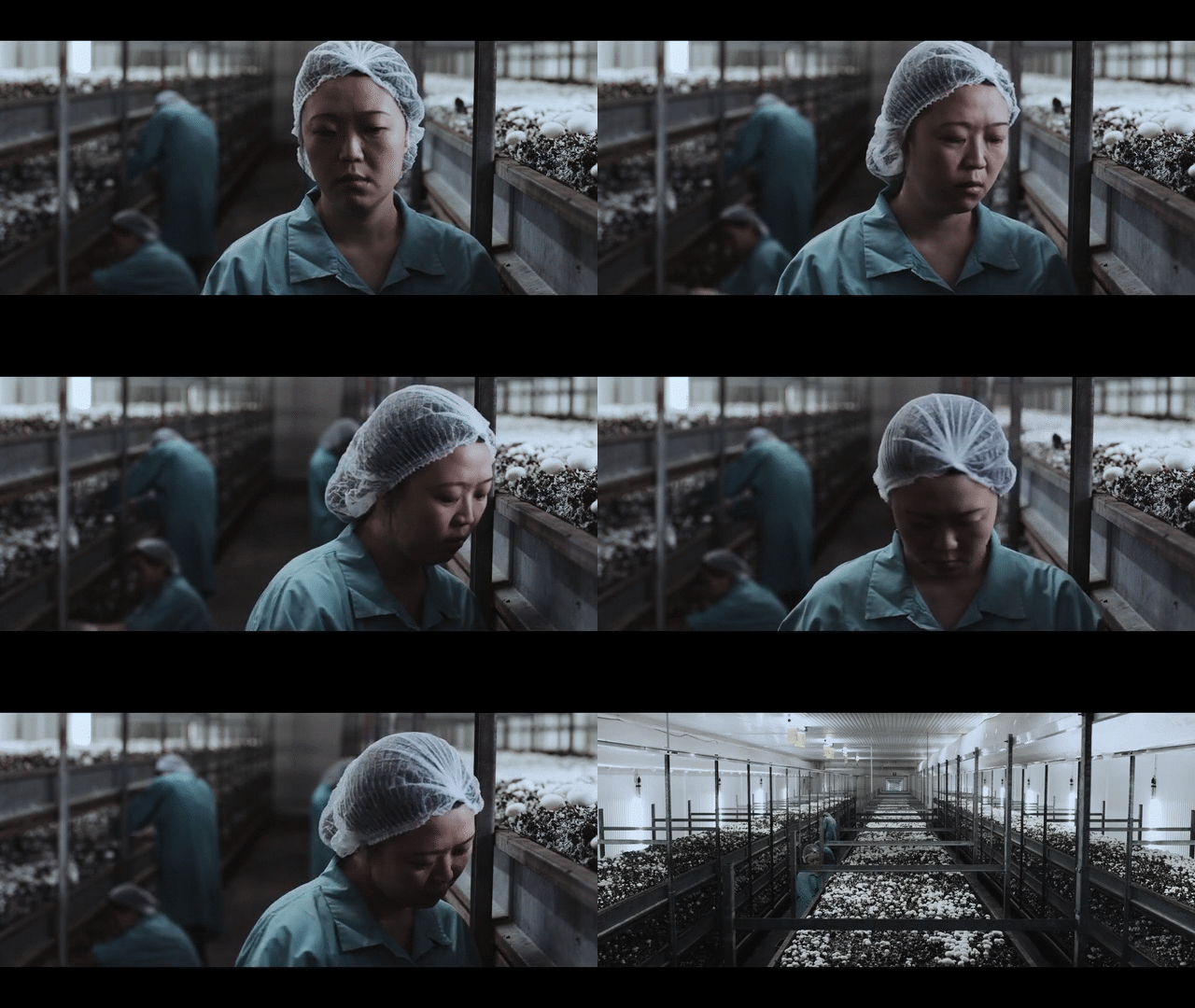
Italian and Chinese Middle LandsFavourite Sara's homework for summer holidays is to grow and take care of a little tomato seedling. But her family lives in a flat, so she will plant it in a small vegetable garden that her grandparents raised in an abandoned and hidden land between town and countryside. The idea of the film is the tip of the iceberg of an etnographic and visual research led in the last years. It is the output of a series of traces, experiences, sensations, listened and imagined stories that take place in the urban-sprawled area of Veneto region of Italy. The research intends to pay attention to the spatial and relational dynamics that affect the margins, understood as interstitial spaces, in this case segments of the "third landscape", spaces that they are usually not considered as identifying and invested with meaning, often invisible places. Sometimes, however, it seems precisely the suspended, hybrid and indecisive status of these spaces to welcome - and in a certain sense reflect - liminal situations, becoming a sort of laboratory and alternative space for relationships: some of these spaces are "adopted" and by individuals or groups are grafted onto them, which activate processes of re-signification, re-appropriation, re-qualification, tracing some points of a new one phenomenology of care. The short film aims to tell one of this experience and how it relates to the surrounding context. - The Chinese female workforce responds perfectly to the logic of industrial production of modern mushroom farms. In particular, the qualities that are appreciated by employers are those of dexterity, precision, speed, resistance to effort, large availability to work and flexibility. Furthermore, “they are not very unionized”. It can be said that the demand for Chinese labor is deeply embedded with the characteristics of the food industry and scale-economies: it constitutes a relatively low-cost, easily replaceable, non-unionized and "silent" labor force, which it allows high and constant production levels, which in turn allow to reduce consumer prices. Shooting a short film allowed me to speak almost freely about these delicate issues. It was a great challenge because both the cast and the crew were Italian-Chinese, in order to live a multicultural and exchange experience. It also was not so easy to find a mushroom farm who allowed us to film.

Middle Lands

Urban Piss-Ups
Filmed in Bruxelles. A woman places a poster in public space with a phone number and the caption "Women Pissers Wanted!". Eight women answer the ad and go to the meeting point: an abandoned basement where a "strategist" waits for them. The strategist gives each woman an envelope containing the coordinates of the places where to intervene by performing a particular act: urinating in the space to leave a mark and to territorialize it. Mark by mark, they territorialize the entire city of Brussels. Will the effect of gender appropriation spread to all the cities of the planet? Director Alice Salimbeni 'In this film, the other co-authors and I sought to explore and represent the feeling of being out of place in the public space of the city of Brussels, as women. To do so, we put ourselves in the position of the Foucauldian "potentia" instead of the "potestas" and we wrote an ironic and parodic urban tale to comprehend our urban feelings. Considering that in Brussels there are many possibilities to urinate standing up (urinals, hidden corners, bars) and few possibilities to do it sitting down (toilets, bars) we have identified the act of urinating as a symbolic container. Urinating in the street means laying bare one's body and not respecting the rules of common living and at the same time it means feeling in a position of power strong enough to be able to do so. Urinating is also a symbolic act that metaphorically evokes the territorialization of the space in which this act is performed. Given the greater ease of men to practice this act, in the film we subvert reality, we identify meaningful spaces that express gender inequalities in Brussels, and we stage a collective act consisting of serial “urban piss-ups" to conquer the city. With the act of urinating, the video represents an exemplification of the denial of a right through a scenario in which that right is distorted, sarcastically acquired by those who do not hold it, and then ironically put into practice.'

Urban Piss-Ups

1 5 6 7 8 9 11