Mystic Chords of Memory
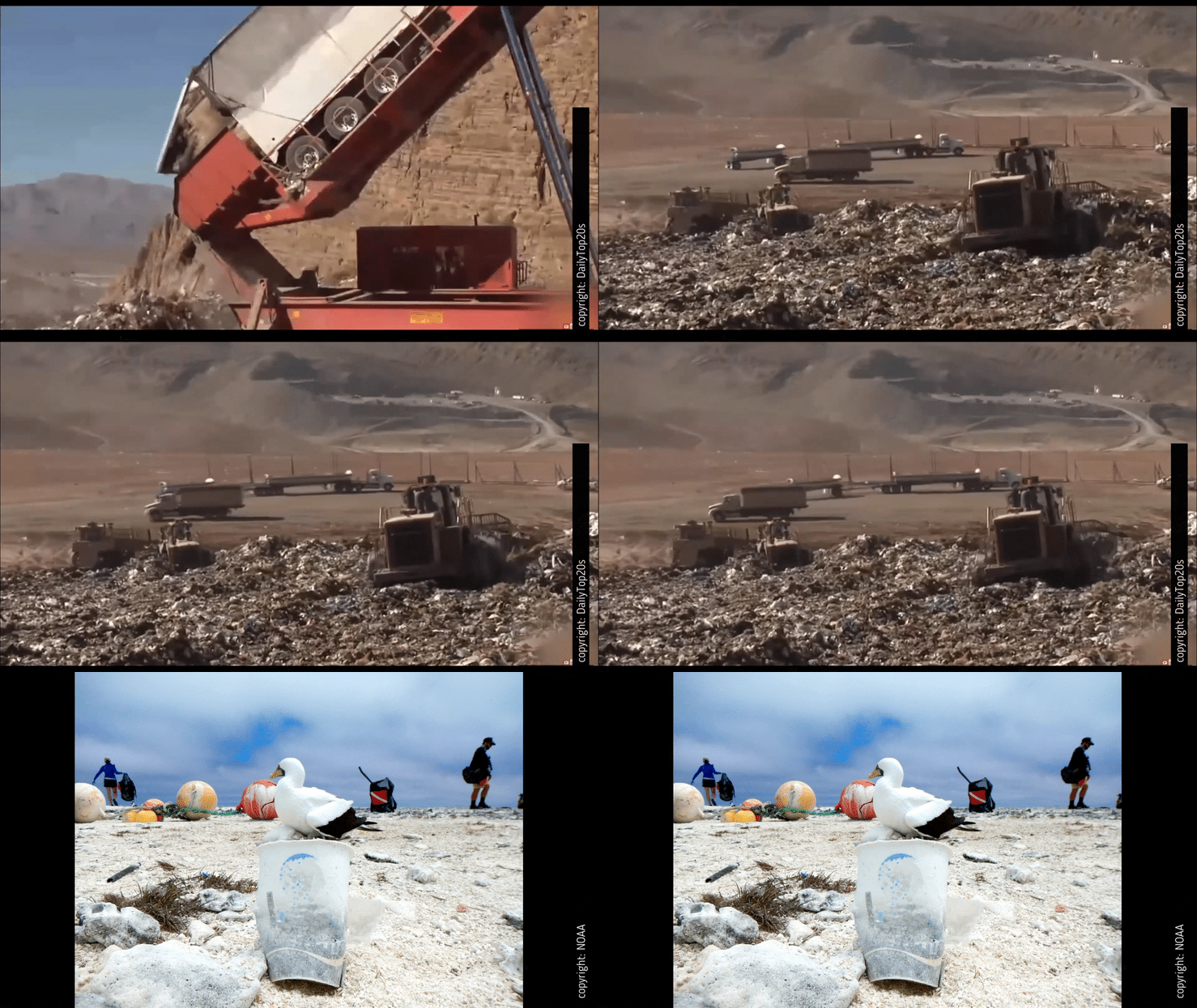
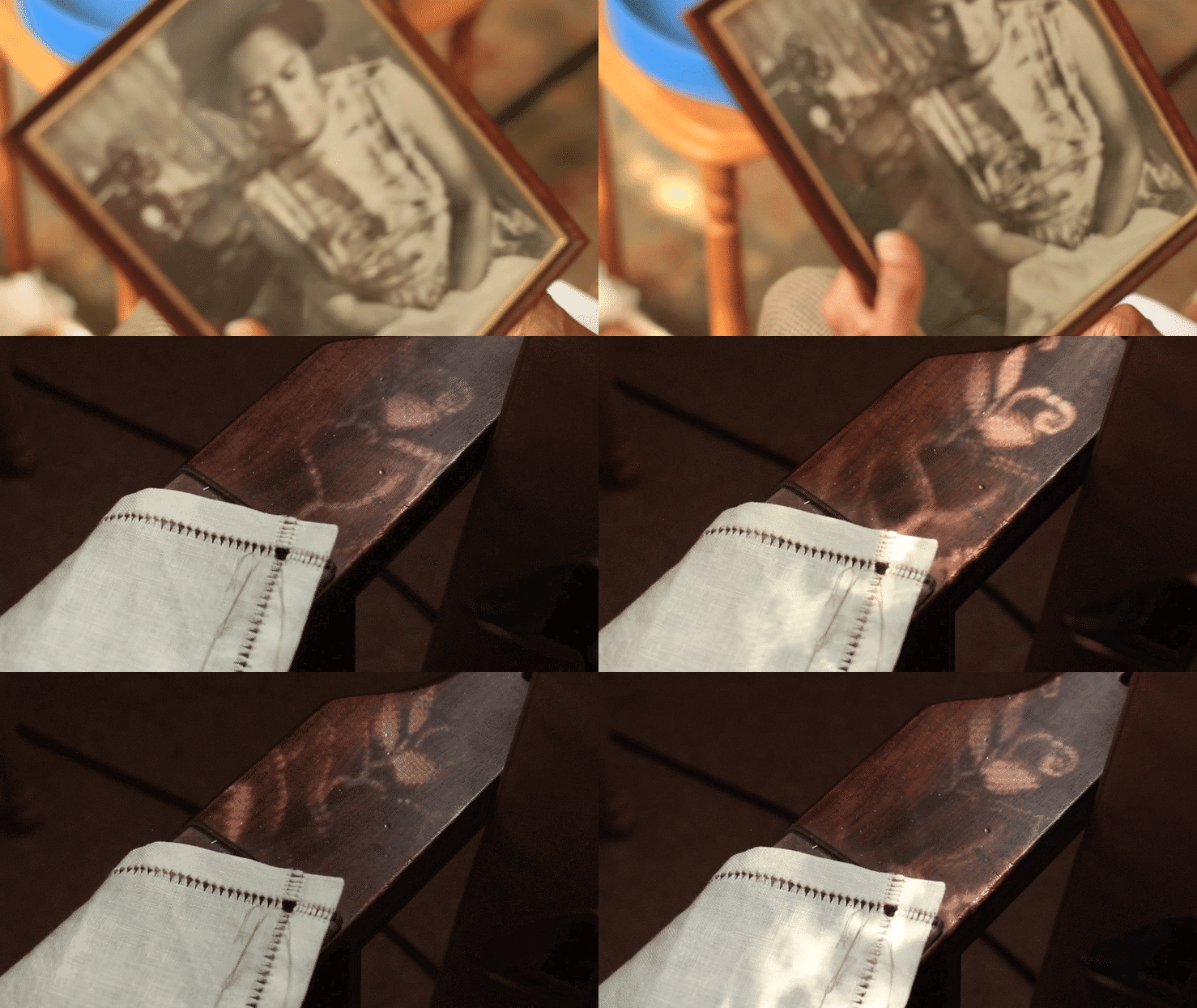
USA Cymru, Wales Cultural Geographies Mystic Chords of Memory explores how people experience and maintain connections to their shared past and culture in Wales, through different kinds of narratives about place. Principal photography took place in summer of 2019, in geographical regions across the country ranging from the coal valleys of the south to Holy Island in the north. The full length film (in post production) features individuals whose knowledge and experiences include coal and slate mining, land-based art practices, folklore and storytelling, holy wells, sheep farming, local and national history, and environmental stewardship. I had a written my masters thesis on sense of place and place attachment, so those concepts were at the forefront of my thinking when I was developing this film. The idea for the film started with my own familial connection to Wales (where I had never been) through my maternal grandmother, and prompted reflection on different forms of relationships to place. I spent almost two years researching different regions, histories and cultural beliefs in Wales before I started planning the shoot. Most of my participant recruitment was accomplished by joining various Facebook groups, as well as through the wonderful nonprofit, Trec (Folk Development for Wales). Selected Reviews Needs subtitles at times, especially for the first speaker (not the narrator). There certainly is a foundation/core of a film here. The part of the two women (wives) reminiscing remind us that despite much of the hardship and loss (and today’s aversion to coal) this history has a very human and social element and shaped lives beyond the work day. Also, as much as I would like more details about place, I also respect that the film is not focusing on “a history of a place”.

Mystic Chords of Memory

Alpen
UK This film is part of a research project exploring the relationship between movement, place and chronic pain. The subject of the film, Emma, lives with persistent pain which contracts her use of space. Emma used to snowboard and Emma could probably still snowboard. This film offers images of Emma moving through familiar pathways in her kitchen overlaid with sounds of snowboarders and the Swiss Alps. Alpen shows something of the intricacy of Emma’s movements: her rolling shifts in weight from side to side, the way she moves her hand to stool to knee on stool, spreading weight through multiple points of support as she moves round and round her kitchen. It points to the creative and highly skilled way that someone with chronic pain navigates and conjures space, and the intense creativity and somatic intentionality of the movement of relapse and recovery, positioning and re-positioning, within the movement of those who live with chronic pain. This work led to further thought concerning the way the constant reparative shifting of weight or position, often demanded by pain, can generate an unsettled embodied affect (a kinaesthetic irritation) in others because it draws attention to pain. Not being to stay in one place signals an unreliable body that keeps changing its plans, having a change of heart , having to lie down and drawing attention to itself by taking up (from a non-pain perspective) too much space. Continuous adjustments like these can create, what film theorist Mary Anne Doane describes as ‘an overly present body’ (1985:206), that is too much where it is. Selected Reviews Interesting use of fixed image on a fridge A wonderful and artful examination of the domestic and intimate space of a kitchen with texts that accompany the wordless unfolding narrative. So many layers can be discussed by students and viewers alike. I like the stark simplicity of this film.

Alpen

When Dance Springs
Japan Japanese with English Subtitles Ethnography Experimental This film is set out to explore the relationship between body and the environment and to express a different perception of Nature, a non Westernized one in which humans are a part of it. Yuki Yuko's image of the body is an extension of her surroundings, and her dance is incessantly a becoming: a snake, a bug, a swan or an animal. Her dance techniques give the impression that even during a conversation or when having lunch she is continually dancing. Yuki Yuko sees that any movement and existence equals with dancing and the film attempts to express the intensity of her dance. I have made this film after 3 years of fieldwork and I purposely opted for a style that would be true to the rhythm of dance, without a narrative. I used an old Sony digital camera that became a part of my own body and the team was formed of 3 women. I have changed roles and made the dancer film some images herself, or the editor be the cinematographer. I purposely cut the sound in some scenes because the dancer whom was participating in the editing process desired it and was a way to express the "silence of her being". This may give the viewer an uncomfortable feeling or the impression the film is not finished or edited correctly but I think bodily expression and perception of sound and mood needs to stay true to images and the unease a viewer perceives is of his own body. I also didn't use any explanations and commentary of the images because in this way the viewer would be more open to understand the images directly the effect he/she would have by watching a performance. Selected Reviews It deals with the personal perception of a single artist. Very unique perspective of a Butoh dancer and how place and nature come together. A brave effort to depict the art of avant garde artist Yuki Yuko who risked being misunderstood but whose engagement with the elements of nature to her dance remains fiercely committed.

When Dance Springs

Migrant Walls
Wellington, New Zealand Spanish (English Subtitles) The film shares the story and insights of the creation of a mural by the Latin American community in Wellington, Aotearoa New Zealand. Led by The Latin Collective, under the guidance of street artist/muralist Alfonso Ruiz Pajarito (Brigada Ramona Parra, Chile), this mural makes visible the presence, contribution and sense of belonging of the Latinxs in Wellington. Involving participants from over 13 Latin American countries, and in collaboration with local communities and artists, the creation of this mural opened spaces for collective reflection. It became an open gift to the city aiming to celebrate diversity, foster inclusion and counter racism. For us the film made a number of contributions: - it provides a record of the massive process we went through producing the mural, its collaborative and community flavor, and particular aesthetics - it voices and help spread the experiences, opinions and aspirations of Latin American migrants in Wellington that underpinned the motivation to do the mural - it gives a real life example of the use of street art to build community and counter racism, especially in the aftermath of the Christchurch terrorist attack against the muslim community in New Zealand, - it showcases a project that bridges generations and cultures, and the importance of, in this particular case, connecting directly with Latin American histories and aesthetics of street art to communicate issues around identity, political struggles and anti-racist discourses, - it provides a testimony for all of us involved in the project of all the hard work, fun, commitment and love we shared in this project. For us to keep those memories alive and feel proud of it. And also, to share them with new migrants and our own kids and grandkids. Selected Reviews Congratulations for the mural and to all people evolved in the project. The film has its value as journalist piece with a point of view from its director. Good dynamic footage for an interesting story. The music plays a great role.

Migrant Walls

Climate Change Stories
USA This film documents an oral history project completed in fall 2020 about people’s personal thoughts and opinions regarding climate change. Interviewees speak about their concern for the future, food security, and climate refugees, as well as hopefulness in everyday actions and the passion of young people to affect positive change. Documenting people’s personal thoughts and reactions about climate change in 2020 was an incredibly meaningful project for me, as I think it was for the narrators as well. At first many of the narrators questioned whether they “knew” anything about climate change and whether they could contribute to the project. I tried to approach the interviews as if I were talking to a friend rather than engaging in academic research and for the most part I think this technique worked. As each interview progressed the narrators became more comfortable conversing about climate issues. As a future archivist, I am aware of the historical significance of these oral histories and I tried to approach the project from the perspective of potential future listeners. At the end of the interviews I asked each narrator the following question: “If you could talk to whoever is listening to this audio recording thirty or forty years from now, what would you tell them? What would you want them to know about climate change in 2020?” Each and every time I asked this question I got goosebumps upon hearing people’s answers. There was such pain and honesty, and yet so much hope in the responses. As the narrators engaged in climate change conversations with me (some of them for the first time!) several common themes of concern and realization began to emerge. Producing a short film about the interviews allowed me to synthesize some of these thematic similarities into a creative and informative package that highlights the work of climate storytelling. I hope too that the narrators came away from our conversations feeling more comfortable about talking with others about the climate crisis. Though it may not seem like much, I think that communication is really a foundational step toward addressing the global climate crisis. Selected Reviews It’s an effective piece overall. Some of the images feel manipulative toward a purely emotional response (the music as well). This is not necessarily a bad thing, but is less critical. Interesting mix of interviews. Bit rough around the edges but it works!

Climate Change Stories

Witnessing Exile
Canada Greece, Macedonia, Serbia, Hungary, Austria and Germany Political Geographies, Social Geographies English Subtitles In 2015-16, Europe was the destination of nearly one million refugees, the majority of whom traveled a historic migratory route through the Balkans to reach Germany. This film examines the trace left by this exodus among those who have witnessed it along the way with a mix of testimonies and analysis of people whose lives were transformed by these journeys. The film aimed to grasp traces, testimonies and memories of the 2015 exodus on the Balkan route. Each protagonist was met on a step of the exodus route, and the whole movie is tracing back the exiles’ journey from Turkey to Germany in 2015-2016. Departing from massive arrival images leaving feelings of “invasion” and crisis in people’s mind, the documentary sought to reach individual perspectives. This posture is fundamental to challenge the dehumanizing process conveyed by imprecise macro data and schematic description of migration trajectories. Gathering testimonies of volunteers and local people confronted to this new migratory reality was also a way to address the gap between the watcher posture and the migrants’ experience, creating a room for identification with the overall situation. The witnesses of exile are from different gender, professional and cultural backgrounds, each of them adding their own story and vision to the big picture. The project aimed to document the lasting consequences of these migrations on people’s minds and lives, traces without physical materiality that needed to be preserved and disseminated. It was my very first filming experience, with a Go-pro Camera and a micro generally used to make interviews with respondents during the research. I realized, when the idea of making a documentary came out of visioning the images, that I really grasped each encounter in a “social scientist way”. I learned much more about the filmmaker reflexes, such as the enlightenment of the background, and other fundamental aspects by working with the Film editor. The encounters were filmed with a very little amount of camera movements and a cuts and in order to give an immersive feeling to the viewed. It was also a filming laboratory for me. As the director of the Canada research chair on global migration, filming this migratory road was a meaningful process in order to make visible and understandable the complexity of migration phenomenon. Doing this two years after the beginning of the exodus was a conscious choice, in order to go out of the “emergency temporality” to reach the traces and collect them. It is an attempt to turn it into an “heritage”. It also, on its pedagogic dimension, show the setup of a social science research through conversations and co-construction of qualitative data. This kind of support can illustrate courses and give an overview of semi-guided interviews for the students. Selected Reviews A wonderful documentary about the Balkan migration. Very compelling narrative style with clear narration. Well financed with map animations and animated respondents. For the requirement of a short film, this film can be also be screened in 3 segments.

Witnessing Exile

Celebrating Tribal Environmental Professionals: Polly Edwards
USA Oklahoma English A portrait of Polly Edwards , a Native American (Caddo) woman who directs Tribal environmental and emergency management programs in Oklahoma. Laurel Smith co-produced with Native undergraduates, Loren Waters (Cherokee and Kiowa) and Mia Riddle (Choctaw, Creek, and Chickasaw). Teaching Objective: To illustrate how Tribal environmental professionals serve their communities and encourage Native youth to consider environmental careers. Inspired by Indigenous media made in Oaxaca, Mexico, I co-produced this 8-minute video with two Native undergraduates, Loren Waters (Cherokee and Kiowa) and Mia Riddle (Choctaw, Creek, and Chickasaw). During the two years it took to coproduce this short film, we learned that Tribal Environmental Professionals (TEPs) serve Tribal and non-Tribal communities by monitoring water and/or air quality, remediating brownfields, managing natural resources, composing funding proposals, and/or overseeing educational outreach. To undertake these tasks, they work with entities such as Oklahoma’s Department of Environmental Quality, research centers at state universities, and federal science agencies such as the United States Environmental Protection Agency (EPA) and the United States Geological Survey. TEPs also collaborate together through organizations such as the Inter-Tribal Environmental Council and the Regional Tribal Operations Committee. We also learned vital clues about key Tribal leaders and Oklahoma representatives in Congress whose efforts led to the emergence of such Tribal environmental programs starting in the early 1990s. Filmmaking allowed us to identify the scope of a larger research project, establish relationships that will facilitate a participatory-as-possible approach, and led to funding for a third TEP video portrait. It also somewhat redressed the hierarchies that all too often characterize research focused on Indigenous geographies. We worked as closely as we could with TEPs, not just to learn about their careers, but also to strategize on what aspects of their education and experience they most wanted to share with us and later viewers. Selected Reviews This is an informative film about the collaborative practices of Tribal Environmental Professionals, what it is and they do, using Polly Edwards as example.

Celebrating Tribal Environmental Professionals: Polly Edwards

Refuge
France Athens, Greece Migrant Crisis, Cities/Urban Life, Housing/Gentrification, Covid-19/Pandemic Turkish (English Subtitles) Following the life of a Turkish political refugee living in a squatted neighbourhood in Athens. My first purpose was to raise the voice of political refugees, who have crossed the borders to escape persecutions in their own countries. I wanted to explore the connection this man has constructed with this alternative living space. The squatted neighborhood is a complex space itself, with its own rules, system and cycle but after all, it is a refuge for refugees from all around the world as well as any one who share the dream of an alternative way of life. This was the biggest squat I have seen and I was fascinated from the collective work that keeps this place alive. In those straitened circumstances, they try to implement a horizontal administrative system based on solidarity. My biggest challenge during the filming was my lack of filming equipment. And also, I think I should have stayed there even more to realize a full-length film about the squats, by listening to more stories to show the different trajectories. As I am a political refugee as well, I face similar difficulties to stay in different European country so I didn't have the means to stay there longer. Selected Reviews An important contemporary testimony with geopolitical value. Stories of exile in Greece, the hardship, the everyday challenges and quotidian ways of living in your adoptive country. Instead of talking heads, talking bodies are shown interspersed with random occurrences in the urban area including people, places, cats, and practices.

Refuge